I walked into the private dining room of a small hotel in Milan on a Tuesday evening expecting nothing more than a good meal.
What I got instead was a masterclass in atmosphere. The ceiling dripped with a cascading Murano glass chandelier.
The walls were lacquered in a deep tobacco that absorbed light rather than reflected it. The marble table caught the candlelight in a way that made every glass of wine look like it belonged in a painting. Nobody spoke for a full thirty seconds after we were seated.
That silence told me everything about what great dining room design actually does. It stops people. It makes them feel something before a single word is spoken.
These 7 ideas will help you create exactly that.
Top 5 Luxury Dining Room Finds on Amazon Right Now
- Christopher Knight Home Evangeline Marble Dining Table — A genuine marble-top dining table with a sculptural gold-finished base that serves as both a functional surface and a statement piece, ideal for homeowners who want authentic material presence without commissioning custom furniture.
- MOD-ART Velvet Dining Chairs (Set of 2) — Deep jewel-toned velvet side chairs with solid brass legs and a tight, tailored silhouette that bring the upholstered richness of a high-end restaurant into a residential dining room.
- Edvivi Marya 6-Light Modern Chandelier — A sculptural, globe-cluster chandelier in an antique gold finish that delivers the visual drama of a designer fixture at a fraction of the atelier price, suited for dining rooms with 9-foot ceilings and above.
- Bloomingville Fluted Glass Vase with Brass Neck — A refined accent piece in amber-tinted fluted glass with an aged brass collar that adds the kind of quiet, considered detail that separates a styled room from a merely furnished one.
- Solino Home 100% Linen Table Runner — A stone-washed pure linen table runner in a palette of muted naturals that brings the textural layering of a European table setting to any dining room, without the stiffness of synthetic alternatives.
The 7 Ideas
Anchor the Room With a Sculptural Chandelier That Does More Than Illuminate
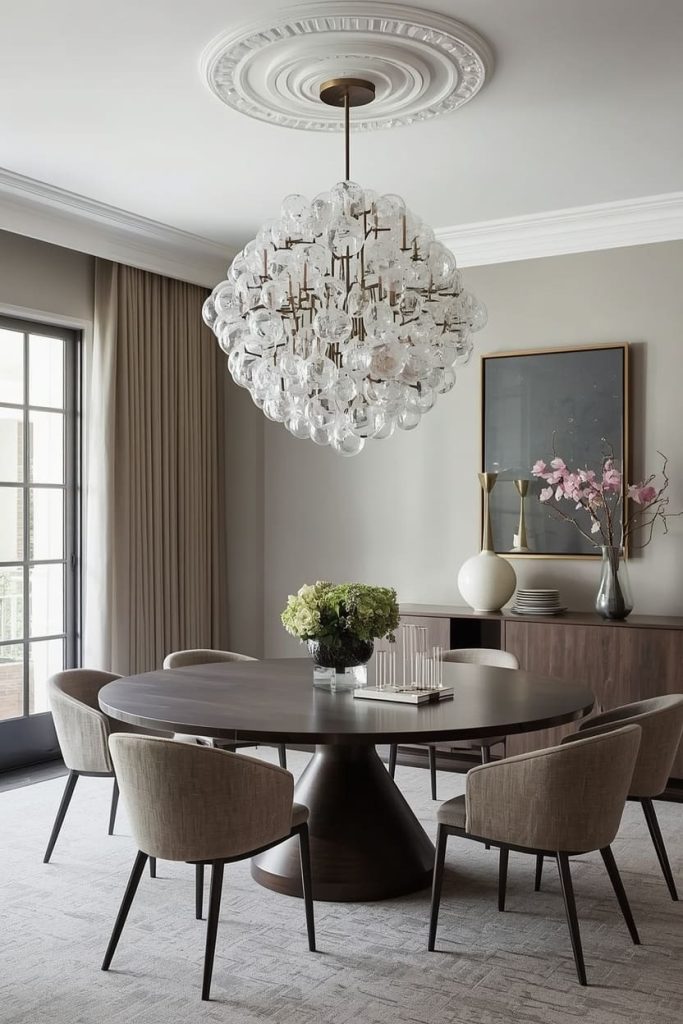
In a modern luxury dining room, the chandelier is never just a light source. It is the first thing a guest’s eye travels to, the piece that establishes the visual register for everything beneath it, and the element that communicates — immediately and without explanation — the level of intention behind the room’s design.
Choosing the wrong fixture is the single most common mistake I see in otherwise well-executed dining rooms.
For a modern luxury context, move away from traditional tiered crystal chandeliers and toward sculptural forms: cascading blown glass globes, organically branching brass armatures, or geometric cage structures in a blackened steel or oxidized bronze finish.
The fixture should feel like it belongs in a gallery as much as a dining room.
Sizing is non-negotiable. Add the length and width of your dining room in feet and convert to inches for your ideal chandelier diameter — a 14×16 foot room calls for a roughly 30-inch fixture. Hang it so the bottom clears the tabletop by 32 to 36 inches.
This idea works for every luxury dining room, but it is most transformative in new builds and full renovations where ceiling height and electrical placement can be planned around the fixture rather than adapted to it.
Clad Your Walls in Lacquer, Limewash, or Venetian Plaster for Depth That Paint Cannot Achieve
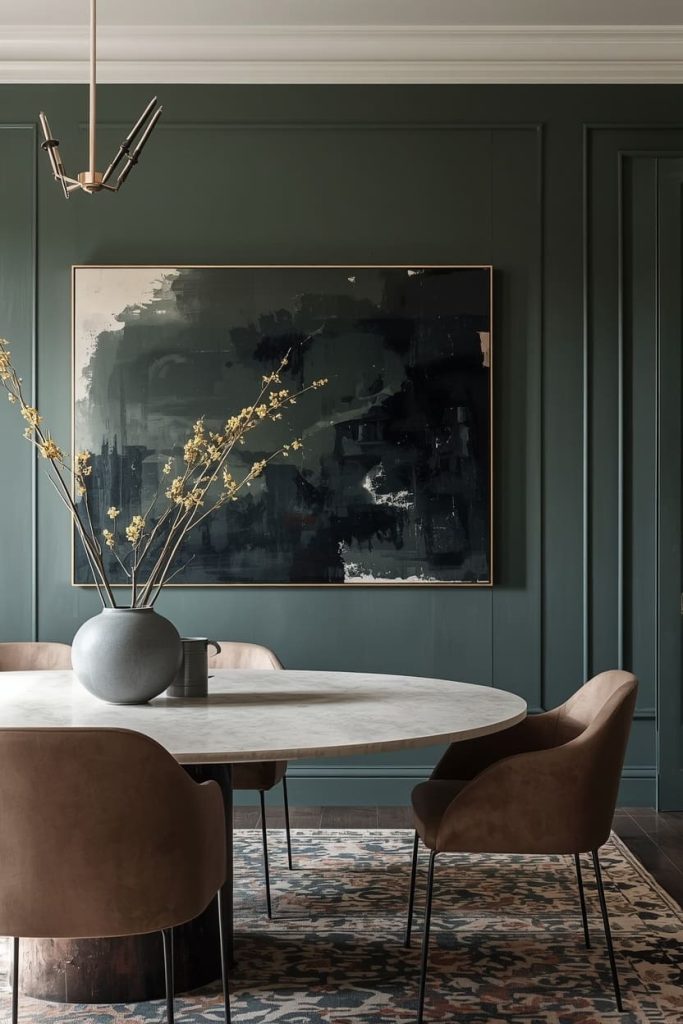
Flat painted walls are the single greatest missed opportunity in luxury dining room design. The wall finish you choose affects how light moves through the room at every hour of the day, and in a dining room — a space used predominantly in the evening — that relationship between finish and light is everything.
Lacquered walls in a deep, saturated tone create a reflective depth that makes candlelight and pendant glow behave like something alive.
Venetian plaster, applied in multiple troweled layers and burnished to a low sheen, produces a surface that reads differently from every angle — dimensional, ancient, and entirely irreplaceable by any paint technique.
Limewash delivers a softer, more atmospheric effect with a chalky, faded quality that suits Italian-inspired or Provençal luxury interiors beautifully.
For color direction, consider deep tobacco, forest green, aubergine, or a near-black navy. These tones do not shrink a room — they give it gravity. Pair any of these finishes with white or cream ceiling plasterwork and the contrast becomes architectural.
This idea suits maximalists and moody interior lovers most naturally, but a soft Venetian plaster in warm greige works equally well in a minimalist luxury context.
Choose a Dining Table in Marble, Sintered Stone, or Bookmatched Veneer as Your Design Foundation
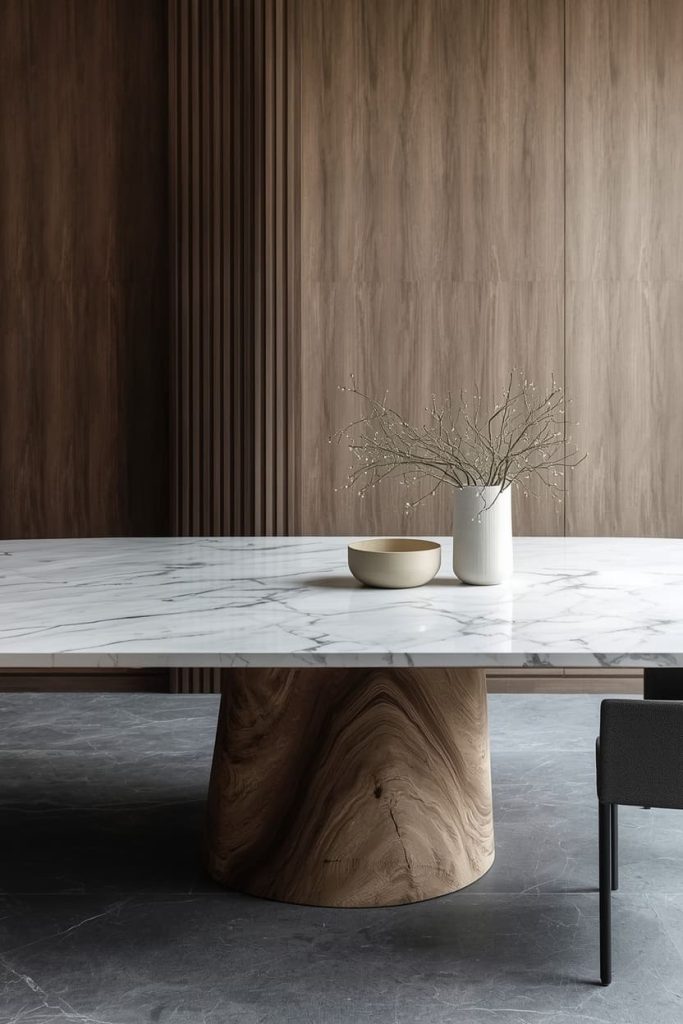
The dining table is the functional and visual center of the room, and in a luxury context, the material it is made from communicates everything. Solid wood, while beautiful, has become the standard — what distinguishes a truly elevated dining room is a table surface that reads as genuinely rare or considered.
Calacatta marble remains the gold standard for formal luxury dining rooms. Its white ground with bold, branching grey and gold veining photographs beautifully and ages with character.
For a more contemporary direction, sintered stone — engineered surfaces like Dekton or Neolith — replicates the visual drama of marble with superior durability and resistance to heat and etching, making it increasingly popular among designers who want luxury aesthetics in actively used spaces.
Bookmatched wood veneer, where two mirrored slices of the same timber are opened like a book to create a symmetrical grain pattern, offers a warmer alternative that still reads as genuinely bespoke.
Pair any of these surfaces with a base in aged brass, blackened steel, or solid turned oak to complete the composition. This idea is most relevant for new builds and full renovations where the table is selected as the room’s anchor piece rather than an afterthought.
Upholster Your Dining Chairs in Boucle, Velvet, or Leather to Layer Tactile Luxury
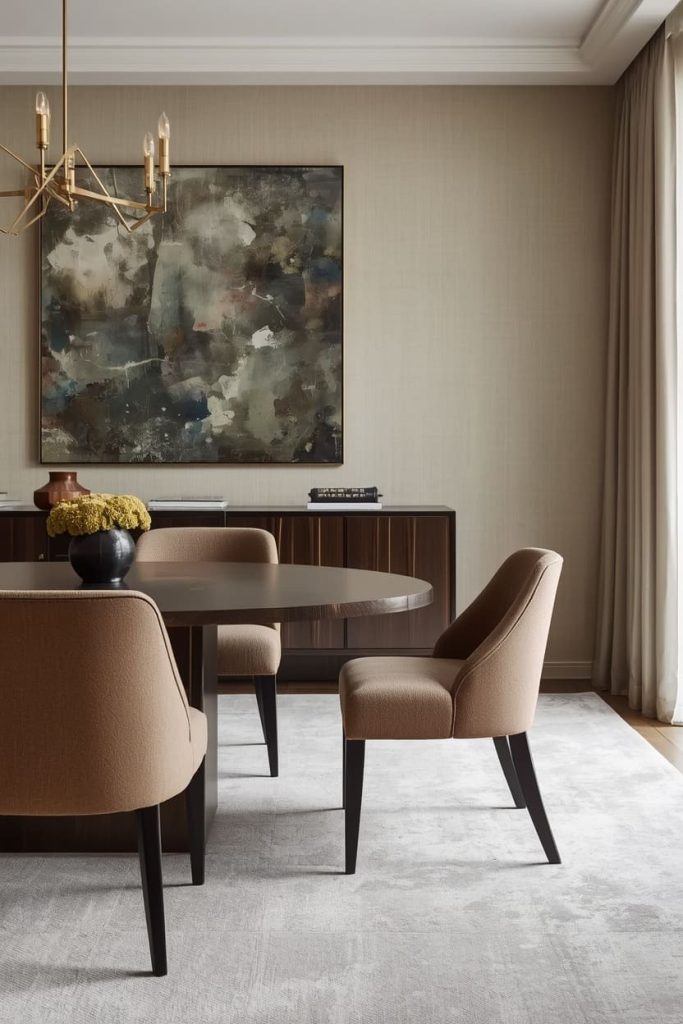
A dining room that looks luxurious in a photograph but feels ordinary to sit in has failed at the most fundamental level. Tactile material is where visual luxury becomes lived luxury, and nowhere is that more apparent than in the dining chair.
The fabric or leather you choose determines how guests feel for the entire duration of a meal — and how the room reads from across a room when the chairs are empty.
Boucle upholstery — the nubby, looped wool-blend fabric that has dominated high-end interiors for the past several years — brings warmth, texture, and a softness that velvet cannot replicate. It works particularly well in dining rooms with a neutral or warm palette where you want richness without color saturation.
Velvet, by contrast, drinks light in a way that makes a dining room feel genuinely opulent — choose a performance velvet in a deep tone like forest green, cognac, or midnight blue for maximum impact.
Full-grain leather dining chairs age beautifully and suit a more masculine, Italian modern direction. Whatever upholstery you choose, ensure the seat height sits between 17 and 19 inches from the floor and leaves 10 to 12 inches of clearance below the tabletop — comfort and proportion are as important as material in a luxury context.
This idea suits every style direction within the luxury spectrum.
Design a Moody, Layered Lighting Scheme Rather Than Relying on a Single Fixture
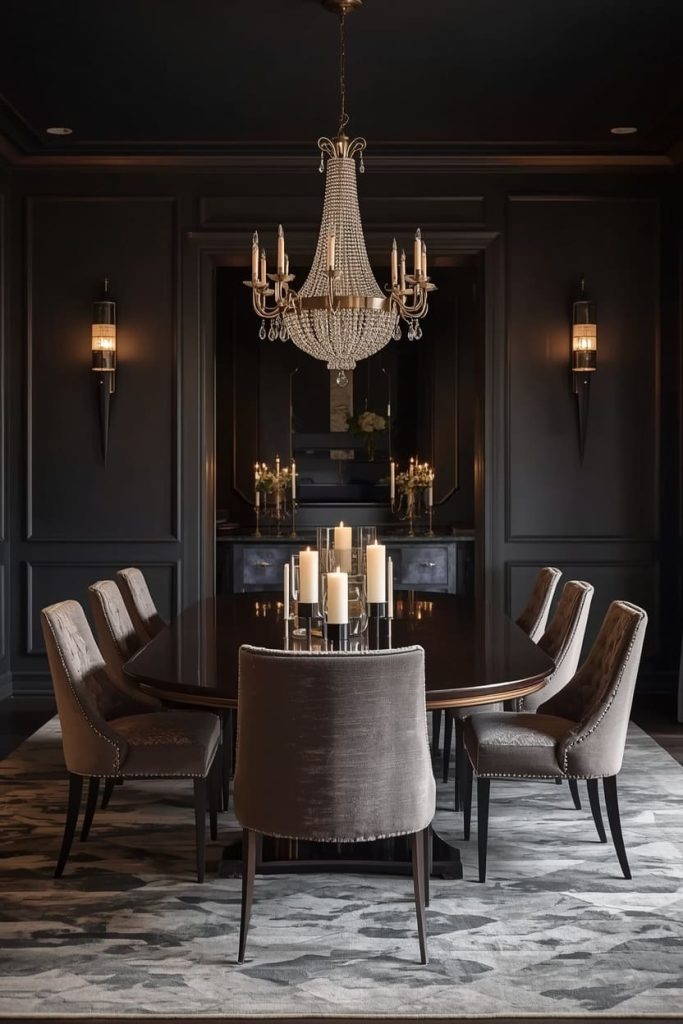
The difference between a luxury dining room and an expensive one often comes down entirely to lighting — specifically, whether the lighting scheme has been designed or merely installed. A single overhead chandelier, however beautiful, produces one quality of light. A layered scheme produces atmosphere, and atmosphere is what you are actually after.
Begin with your chandelier as the ambient anchor, but always connect it to a dimmer — the ability to drop the chandelier to 30 percent at dinner and raise it to full brightness for daytime use is essential.
Then add accent layers: picture lights over any artwork or mirrors on the dining room walls, LED strip lighting inside glazed cabinet interiors if you have built-in storage, and candles — always candles — on the table itself and on any sideboard or console.
Warm white bulbs in the 2700K range are non-negotiable in a luxury dining context. Anything cooler reads as clinical and undoes the warmth of every other material decision in the room.
Dimmer-controlled wall sconces on either side of a sideboard or fireplace add the final layer of graduated warmth that makes a dining room feel genuinely enveloping after dark. This idea applies universally but rewards most generously in dining rooms with dark wall finishes.
Introduce a Statement Sideboard or Credenza as Both Storage and Sculpture
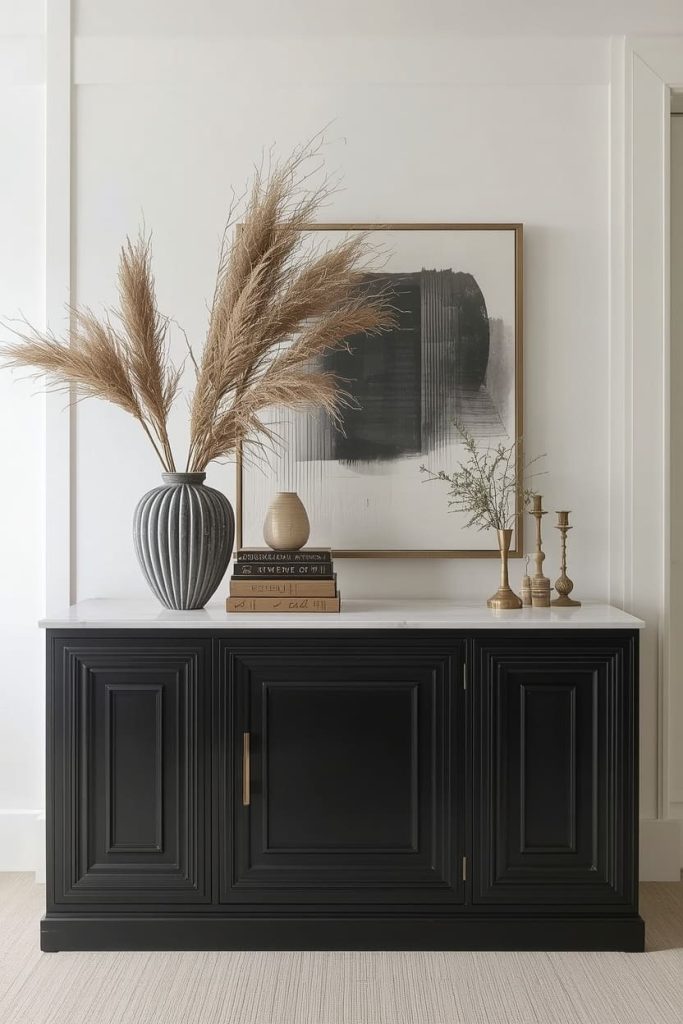
The sideboard is the most underinvested piece of furniture in most dining rooms, which is exactly why getting it right creates such a disproportionate design return.
In a modern luxury dining room, the sideboard or credenza functions simultaneously as practical storage, a surface for tablescaping and display, and — when chosen well — a sculptural object in its own right.
Look for sideboards with genuine material interest: a lacquered cabinet in a deep olive or burgundy with aged brass hardware, a fluted oak credenza with a honed marble top, or a high-gloss lacquered piece with recessed pulls in a matte black or gunmetal finish.
The front face of the sideboard is what the room sees — choose a design where that face has architectural detail, whether through cane paneling, fluted woodwork, or a graphic inlaid pattern.
Style the top surface with intention: a large-scale ceramic vessel, a curated stack of design books, a sculptural candleholder in cast brass, and a low arrangement of dried or fresh botanicals.
Restraint matters here — three to five considered objects outperform a crowded surface every time. This idea works for renovation projects and new builds equally, and it particularly suits homeowners who entertain formally and need elegant serving and display space.
Frame the Room With Architectural Detail — Paneling, Cornicing, or a Coffered Ceiling
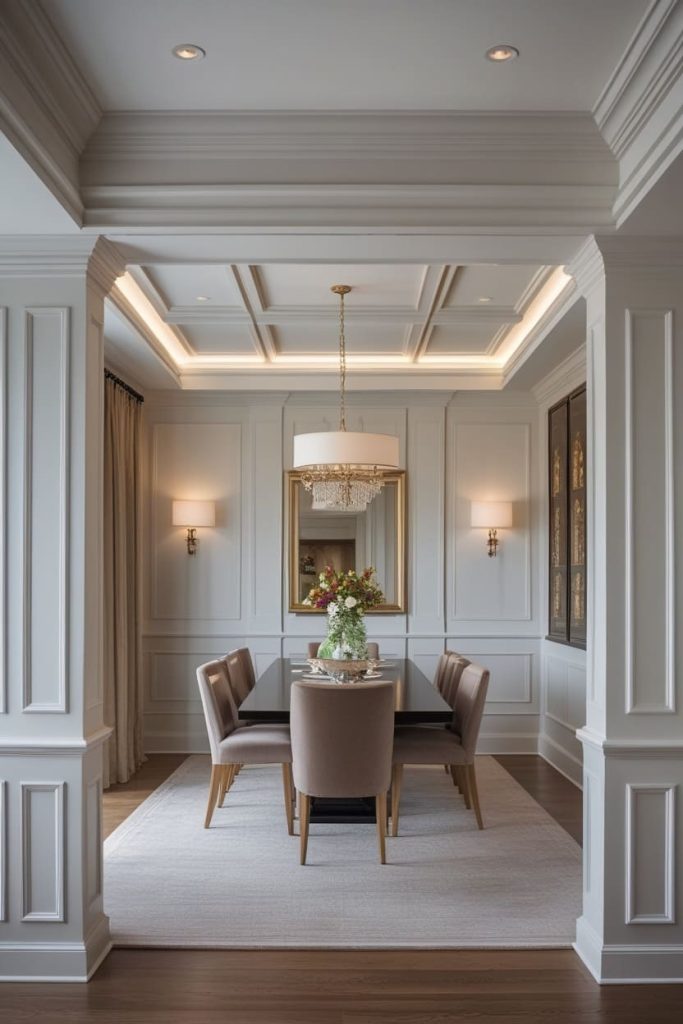
No amount of beautiful furniture can compensate for a dining room that lacks architectural bones. In the most memorable luxury dining rooms I have visited — whether in private homes or design hotels — the walls and ceiling contribute as much to the sense of quality as anything sitting on the floor. Architectural detail is the invisible infrastructure of a truly elevated interior.
Wall paneling in a dining room — whether full-height shaker-style paneling painted in a deep lacquer, fluted MDF paneling used as a textural wainscot, or bespoke joinery with integrated display niches — adds the kind of crafted permanence that no paint treatment alone can replicate.
Coffered ceilings, where the ceiling plane is divided into recessed panels, bring a formal grandeur that suits Georgian, Italian modern, and contemporary transitional dining rooms equally.
For renovations where structural changes are not possible, applied molding — chair rails, picture rails, deep cornice molding, and ceiling medallions — achieves a similar sense of architectural investment at a fraction of the cost.
Paint the walls and moldings in the same deep tone for a tonal effect that reads as intentional and sophisticated rather than dated. This idea delivers the most impact in new builds and full renovations where architectural decisions can be made from the ground up.
Frequently Asked Questions About Modern Luxury Dining Room Design
What materials define a modern luxury dining room?
The materials that consistently appear in high-end dining rooms include Calacatta or Statuario marble, sintered stone surfaces, full-grain leather and performance velvet upholstery, aged or unlacquered brass hardware, solid oak or walnut joinery, and Venetian plaster or lacquered wall finishes. The common thread is that every material rewards close inspection — it looks more considered and more refined the closer you get to it. Luxury materials also tend to age with character rather than deteriorating, which is part of what justifies the investment.
How do I choose the right chandelier size for a formal dining room?
The most reliable sizing method is to add the length and width of your dining room in feet and convert that number directly to inches — the result is your ideal chandelier diameter. A 14×18 foot dining room calls for approximately a 32-inch fixture. Hang the bottom of the chandelier 32 to 36 inches above the tabletop for intimate but unobstructed light. In rooms with ceilings above 10 feet, you can go slightly larger and hang slightly higher without losing the sense of intimacy.
What is the best color palette for a moody, luxurious dining room?
Deep, saturated tones consistently outperform neutral palettes in creating genuine dining room atmosphere. Forest green, tobacco brown, aubergine, deep navy, and near-black charcoal all create the kind of enveloping quality that makes a dining room feel like a destination rather than a passthrough. Pair any of these wall tones with warm white or cream ceilings, natural brass or bronze metalwork, and warm-white lighting at 2700K to prevent the room from reading as cold or oppressive.
How do I mix metals in a luxury dining room without it looking busy?
The key is to establish one dominant metal and use one or two secondary metals as deliberate accents — never more than three total. Aged brass or unlacquered brass is the most versatile dominant metal in a modern luxury context, pairing cleanly with blackened steel as an accent and warm bronze as a secondary. Avoid mixing metals that sit too close on the color spectrum, such as polished gold and brushed champagne, as the similarity reads as inconsistency rather than intention. If every metal in the room is clearly distinct in finish and tone, the combination will feel curated rather than chaotic.
What is the difference between modern luxury and contemporary design?
Contemporary design refers to what is current — it is a moving target that reflects whatever aesthetic language dominates a given moment. Modern luxury is a specific and more enduring design philosophy that prioritizes quality of material, restraint of composition, and the long-term coherence of a space over trend responsiveness. A modern luxury dining room might incorporate contemporary elements, but its foundation is always craftsmanship, considered proportion, and the deliberate selection of materials that improve with age rather than date quickly.
You already know what your dining room is missing — you have probably known for a while. The velvet chairs, the dramatic wall color, the chandelier that stops people the moment they walk in.
Commit to one decision this week, not the whole room at once. Order the chairs. Book the plasterer. Choose the paint. Every genuinely beautiful interior began with a single moment of decisive taste, and yours is waiting for exactly that.

Jenny is a passionate writer specializing in home decor, design, and styling. With years of experience in transforming spaces, she shares expert tips on creating beautiful, functional homes. From interior design trends to DIY decor ideas, Jenny’s work helps homeowners craft spaces that reflect their unique style. Whether it’s a cozy living room, a modern kitchen, or a serene bedroom, her articles offer practical advice and inspiration to elevate any home.