I still remember the exact moment I fell in love with dark dining rooms. It was a rainy Tuesday evening at a small Italian restaurant tucked into a side street — the kind of place with black walls, flickering candlelight, and deep burgundy velvet chairs.
Something about sitting in that dim, enveloping space made the food taste better, the conversation flow easier, and the whole evening felt cinematic. I drove home that night thinking, why don’t more homes feel like this?
That question sent me down a deep rabbit hole of moody interiors, and I have never looked back. If you have been dreaming of a dining room that feels dramatic, intimate, and utterly sophisticated, these seven ideas are for you.
My Favorite Dark Dining Room Picks on Amazon
- Black Velvet Dining Chairs — These tufted, high-back velvet chairs instantly anchor a moody dining space with texture and old-world glamour.
- Matte Black Adjustable Pendant Light — A cluster of matte black pendants hung low over your table creates that coveted candlelit restaurant effect at home.
- Dark Walnut Solid Wood Dining Table — A richly grained dark walnut table becomes the dramatic centrepiece every moody dining room needs.
- Brass and Black Taper Candle Holders (Set of 3) — These sleek mixed-metal holders add warmth and ceremony to your table styling without any effort.
- Peel-and-Stick Dark Botanical Wallpaper — A removable wallpaper in deep forest green or midnight black botanical print transforms one wall in an afternoon.
The 7 Ideas
Go Dark, Go Bold
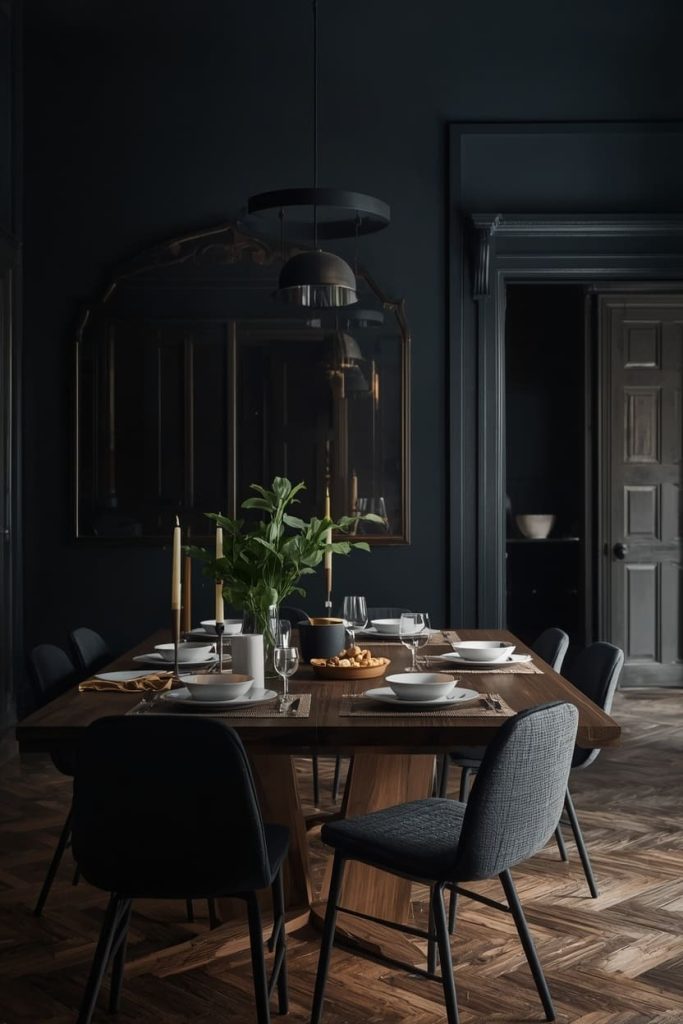
The single biggest fear I hear from people considering dark walls is that the room will feel like a cave. Here is what I have learned: the right dark color actually makes a room feel more defined and purposeful, not smaller.
The key is choosing a shade with warm undertones rather than cold ones. Deep charcoal with a brown base, dark forest green, inky navy, and smoky aubergine all absorb light in a way that feels rich rather than flat.
I personally love Farrow & Ball’s Railings or Benjamin Moore’s Black Panther for dining rooms because both have enough warmth to glow beautifully under candlelight.
Paint all four walls, the ceiling, and even the trim in the same color for a truly immersive, cocooning effect. This technique — called “color drenching” — is one of the most transformative things you can do in a dining room. Pair your dark walls with warm white or cream tableware and light wood accents to stop the room from feeling heavy. A large mirror on one wall will also bounce light around and add depth without breaking the mood.
Layer Your Lighting
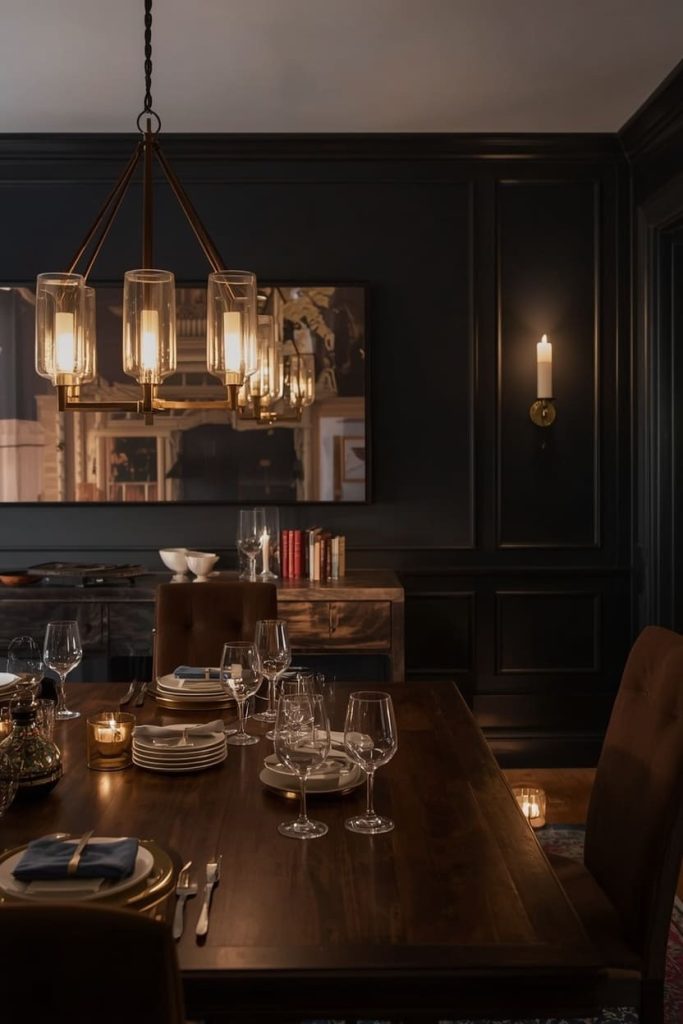
You can paint your walls the darkest shade on the color card, but if your lighting is wrong, the whole effect falls flat. I learned this the hard way when I installed a single overhead fixture and the room looked more gloomy than glamorous.
The solution is layered lighting — combining at least three different sources at different heights to create dimension and warmth.
Start with a statement pendant or chandelier hung low over the dining table, ideally on a dimmer switch. Then add wall sconces at eye level to create a soft, flattering glow around the perimeter of the room.
Finally, bring in table-level light through candles — real ones, pillar candles, or even high-quality flameless versions if you have children. The combination of overhead, mid-level, and table-level light mimics exactly what those moody restaurants do so well.
Warm-toned bulbs in the 2700K range are non-negotiable here; cool white bulbs will kill the atmosphere entirely. Dimmers on every fixed light source give you full control over the mood from dinner party to quiet weeknight supper.
Velvet Meets Wood
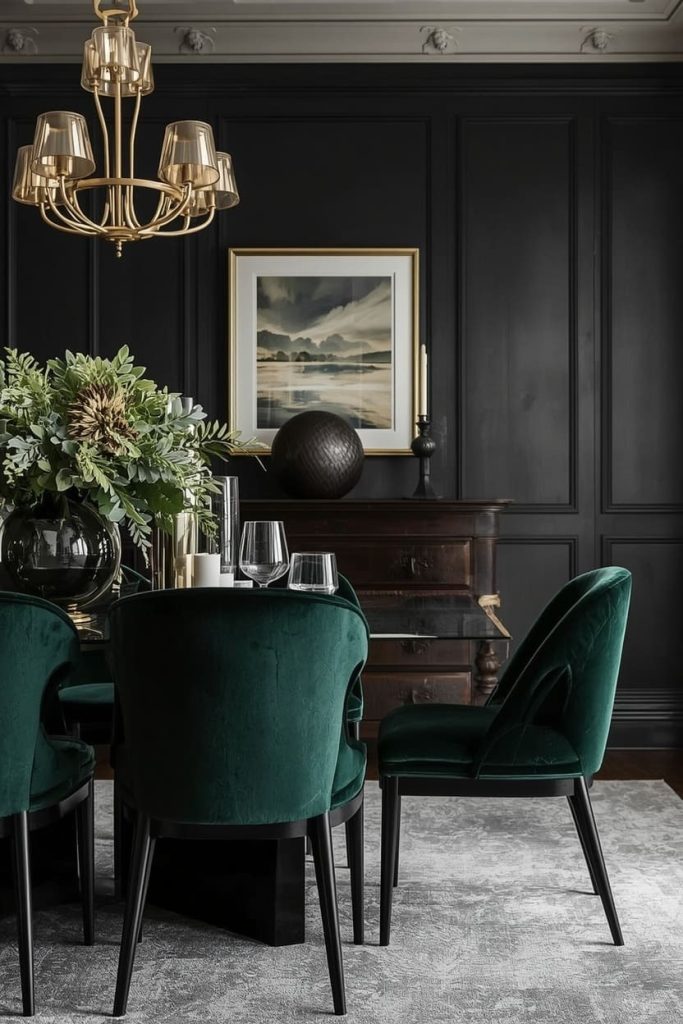
A dark dining room that only relies on color will always feel a little one-dimensional. Texture is what takes it from interesting to genuinely luxurious, and the combination of velvet upholstery and dark wood grain is one of the most satisfying pairings in interior design.
I think of it as the visual equivalent of a cashmere sweater — deeply pleasing to both the eye and the hand.
Start with your dining chairs. Velvet in deep jewel tones — emerald, sapphire, forest green, or wine — works beautifully against dark walls because it absorbs light softly rather than reflecting it. If you want to keep the chairs neutral, charcoal or slate grey velvet is endlessly sophisticated.
Then bring in dark wood through your dining table, a sideboard, or even picture frames and wooden candlestick holders. The grain of walnut, ebony-stained oak, or dark mango wood adds organic warmth that prevents the room from feeling too sleek or sterile.
Together, velvet and dark wood create a room you genuinely want to linger in long after the plates are cleared.
One Wall Wonders
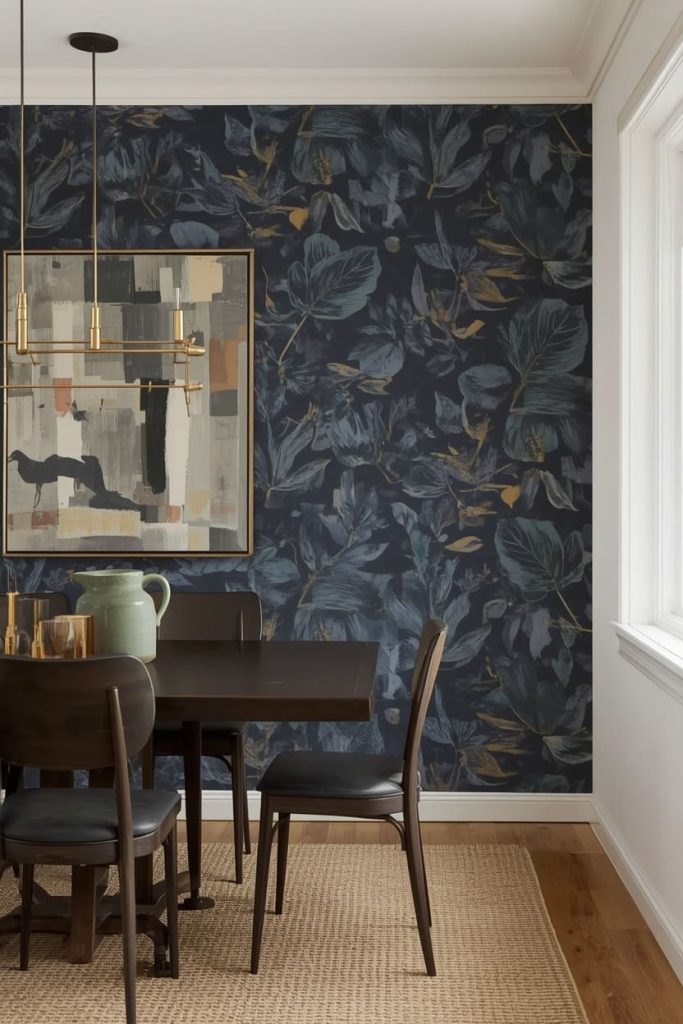
Not everyone is ready to paint all four walls dark, and that is completely fine — one well-chosen accent wall can deliver just as much impact. Wallpaper is my favorite tool for this because it adds pattern and texture on top of depth of color, which plain paint simply cannot do.
A single wall of dark botanical wallpaper, moody maximalist print, or inky geometric pattern behind your dining table instantly becomes a focal point that anchors the entire room.
If you are renting or just want the flexibility to change things up, peel-and-stick wallpaper has come a very long way in terms of quality and print variety.
For a permanent installation, look for papers in deep backgrounds — midnight blue with gold leaf motifs, charcoal with abstract brushstroke prints, or forest green with oversized tropical leaves are all current favorites.
Keep the remaining three walls in a complementary neutral — warm greige, soft white, or a muted sage — so the feature wall does the talking without competition.
Add a picture light above the wall to highlight the pattern and make it feel intentional and gallery-worthy.
Style Your Table
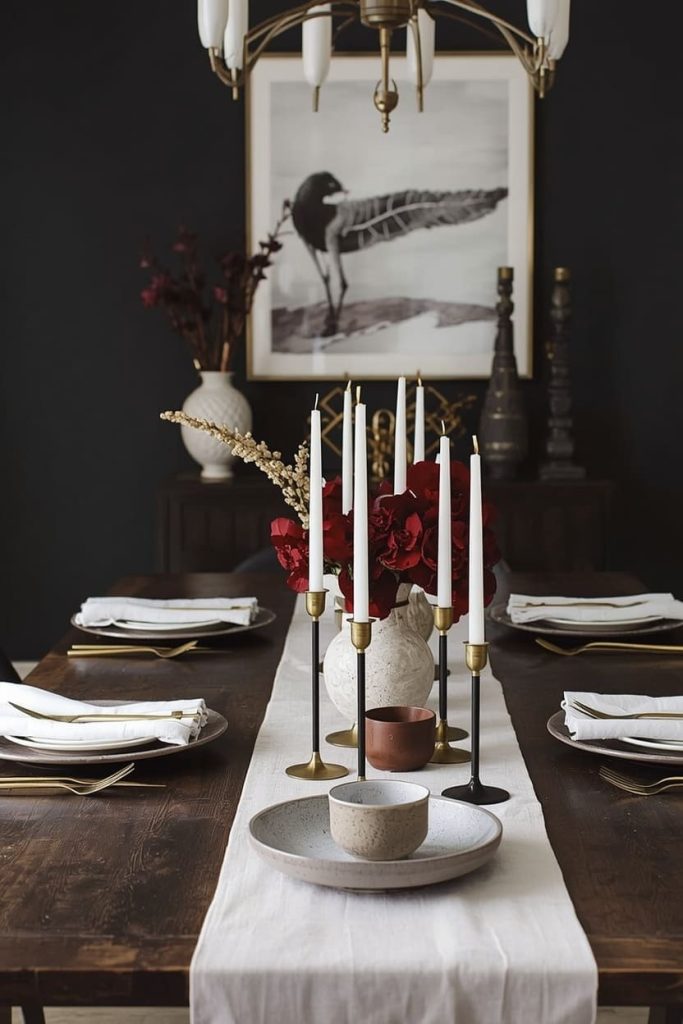
The table itself is your daily canvas, and in a dark dining room, your table styling choices become even more visible and impactful.
I used to think table styling was only for dinner parties, but a thoughtfully arranged table actually makes the whole room feel more curated and intentional even on a regular Tuesday morning.
In a dark dining room, contrast is your best friend at the table level. Think crisp white linen napkins, cream ceramic plates, or pale marble serving boards against a dark wood surface — the visual pop is immediate and stunning.
Add height through a cluster of taper candles in varied brass or black candleholders placed asymmetrically down the center of the table. A low vase of dark-toned flowers — burgundy dahlias, dried pampas grass, or deep red roses — adds organic softness without competing with the room’s moody palette.
For everyday styling, keep it minimal: three candles, a small ceramic bowl, and a linen runner is all you need to make the table feel styled rather than set.
Warm It With Metallics
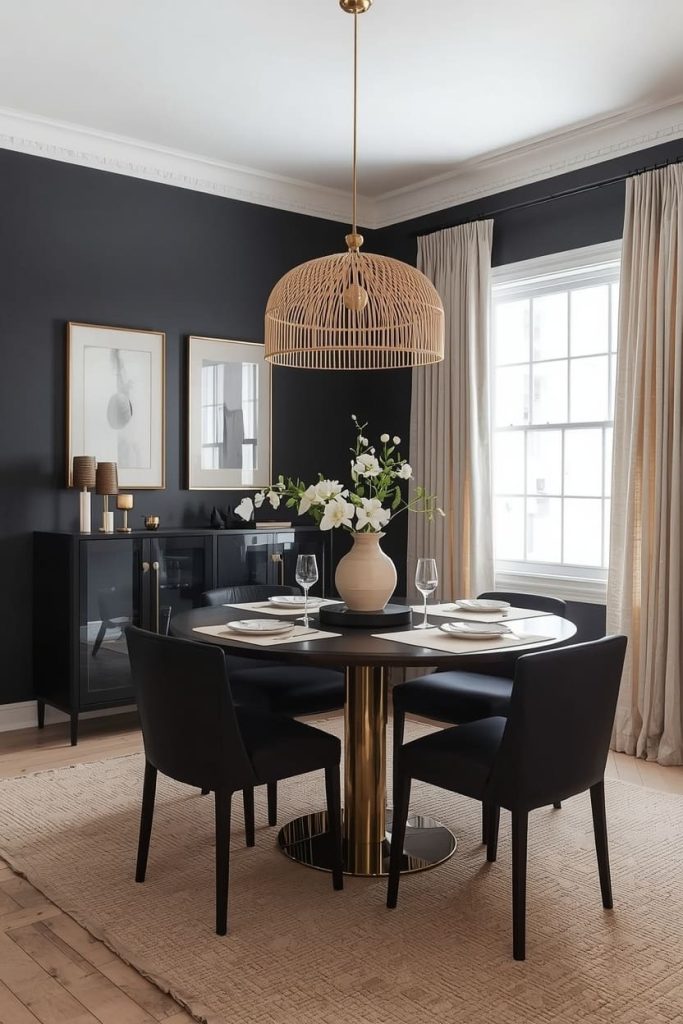
One of the most common mistakes in dark dining rooms is forgetting to add warmth, and the result is a space that feels cold and unwelcoming despite all its drama.
The fix is surprisingly simple: introduce metallics and natural materials throughout the room to reflect light and add organic texture. This is the detail that separates a magazine-worthy dark dining room from one that just feels dim.
Brass is my personal favourite metallic for dark spaces because its warm, golden tone glows beautifully under candlelight and complements jewel-toned walls without clashing. Look for brass in your light fixtures, cabinet hardware, picture frames, and cutlery.
Alongside metallics, natural materials like rattan, linen, raw clay, and live-edge wood add tactile warmth that no paint color can replicate. A rattan pendant shade, a linen tablecloth, or a raw clay vase introduces an earthy counterbalance to all that dramatic darkness.
The interplay between moody depth and warm, natural warmth is what gives a dark dining room its soul — and makes it a place people genuinely love to spend time.
Small Room, Big Drama
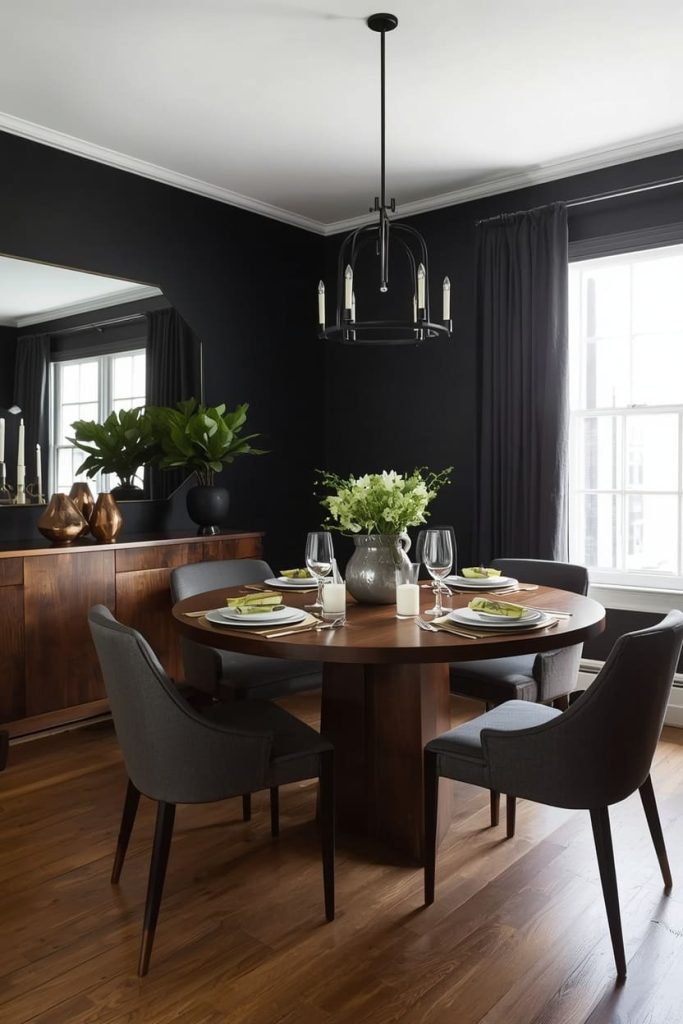
If your dining room is on the smaller side, the idea of going dark might feel counterintuitive — and I understand that hesitation completely.
But here is the thing: a small room painted in a carefully chosen dark color often feels more elegant and intentional than the same room painted white, because the darkness removes the hard, boxy sense of the walls and replaces it with atmosphere. The room stops feeling like a box and starts feeling like a jewel.
To maximize the effect in a smaller space, choose furniture with slim, tapered legs rather than bulky bases — this keeps the floor visible and the room feeling open. A round dining table works better than a rectangular one in tight spaces because it allows easier movement and has no sharp corners to navigate.
Hang a large mirror on one wall to visually double the depth of the room and bounce your candlelight beautifully.
Keep your window treatments light and sheer rather than heavy curtains so natural light can still pour in during the day. The goal is a room that feels intentionally intimate — not cramped.
Frequently Asked Questions
Won’t a dark dining room make my space feel too small and claustrophobic?
This is the most common concern I hear, and the honest answer is: only if it is done without intention. When you choose warm-toned dark shades, layer your lighting correctly, and keep furniture proportionate to the space, a dark room actually feels more intimate and cosy than oppressive. Mirrors, sheer curtains, and slim-legged furniture are your best tools for keeping a smaller dark dining room feeling open and elegant.
What is the best dark paint color for a dining room with limited natural light?
In low-light dining rooms, go for dark shades with warm or earthy undertones rather than cool, bluish ones. Deep olive green, warm charcoal, dark terracotta, and moody taupe all perform beautifully in rooms that don’t get much sun because they glow warmly under artificial light. Avoid cold greys and stark blacks in low-light spaces as these can lean gloomy rather than dramatic.
How do I stop my dark dining room from feeling outdated in a few years?
The key is building on a foundation of classic, timeless choices rather than trendy ones. Deep navy, forest green, and warm charcoal have been sophisticated dining room colors for decades — they are not going anywhere. Where you can afford to follow trends is in smaller, changeable elements like table styling, soft furnishings, and accessories, which you can swap out seasonally without repainting.
Can I mix dark walls with light or natural wood furniture?
Absolutely — and in fact, this contrast is one of the most visually striking combinations you can create. Light oak, natural rattan, or bleached wood furniture against dark walls creates a beautiful Scandinavian-meets-moody aesthetic that feels both dramatic and fresh. The contrast stops the room from feeling too heavy and brings in a sense of natural lightness.
Do I need to repaint the ceiling dark too, or can I leave it white?
Both approaches work, but they create very different effects. A white ceiling with dark walls gives the room a more traditional, grounded feel and keeps the space feeling taller. Painting the ceiling the same dark color as the walls — color drenching — creates a fully immersive, cocoon-like effect that is deeply atmospheric and increasingly popular in modern interiors. If you are nervous, start with white and see how you feel — you can always go darker later.

Jenny is a passionate writer specializing in home decor, design, and styling. With years of experience in transforming spaces, she shares expert tips on creating beautiful, functional homes. From interior design trends to DIY decor ideas, Jenny’s work helps homeowners craft spaces that reflect their unique style. Whether it’s a cozy living room, a modern kitchen, or a serene bedroom, her articles offer practical advice and inspiration to elevate any home.