I had the table. I had the chairs. I even had the rug and the pendant light centered perfectly overhead.
But every time I walked into my dining room, something felt off — like a sentence that ends without a period. The room looked functional but not finished.
Then I added a sideboard to the empty wall across from the table, and I finally understood what had been missing.
That one piece gave the room storage, symmetry, a styling surface, and a soul.
If your dining room feels like it’s almost there but not quite, I think a sideboard is the answer you’re looking for — and these seven ideas will show you exactly how to make it work.
Table of Contents
- Size Your Sideboard Correctly So It Fits the Room — Not Just the Wall
- Style the Top of Your Sideboard the Way a Designer Would
- Turn Your Sideboard Into a Home Bar That's Ready When You Entertain
- Match Your Sideboard Finish to Your Table Without Being Too Matchy
- Add Lighting Above or On Your Sideboard to Transform the Room at Night
- Use the Inside of Your Sideboard to Solve Your Dining Room Storage Problem
- Use Your Sideboard as the Anchor for a Gallery Wall That Makes the Room Feel Complete
Top 5 Modern Sideboards to Shop Right Now (Available on Amazon)
- Nathan James Taryn Mid-Century Sideboard in Walnut — Its warm walnut finish and tapered legs bring that classic mid-century modern character that pairs beautifully with both wood and upholstered dining sets.
- Belleze Minimalist Buffet Cabinet in White Matte — A clean, handle-free front and matte white finish make this the perfect understated piece for a Scandinavian or contemporary dining room.
- Ironck Industrial Sideboard in Black Metal and Wood — The black metal frame combined with a natural wood top creates a bold modern contrast that works especially well in loft-style or urban dining spaces.
- HOMCOM Slim Low-Profile Credenza in Oak — At just 13 inches deep, this slim credenza fits against even the most narrow dining room walls without interrupting the flow of the space.
- FUFU&GAGA Scandinavian Sideboard with Angled Legs — Elevated on angled legs with a light wood finish, this piece keeps the floor visible and the room feeling airy and open.
The 7 Sideboard Ideas To Fill Up The Empty Space Of Your Dining Room
Size Your Sideboard Correctly So It Fits the Room — Not Just the Wall
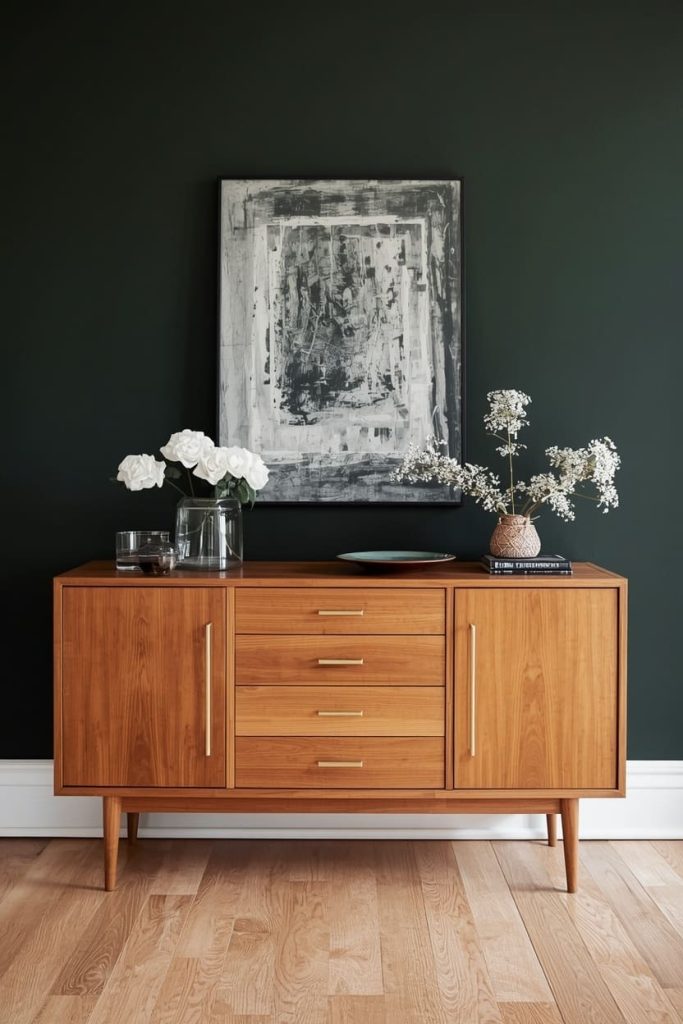
Before I fell in love with a sideboard online and bought it without measuring, I wish someone had told me this: the wall length is only part of the equation.
Proportion matters just as much, and getting it wrong makes even a beautiful piece look awkward and out of place.
The general rule I follow now is that your sideboard should span roughly two-thirds of the wall it sits on — not the full length, and not less than half.
That ratio gives the piece visual weight without making the room feel cluttered. For most standard dining rooms, that lands you somewhere between 55 and 72 inches wide.
Height is the other variable people overlook. Most sideboards fall between 30 and 36 inches tall, and that range works well in dining rooms because it keeps the top surface at a comfortable serving height and sits below the sightline when you’re seated at the table.
If you have high ceilings, you can go taller — but in a standard 8-foot ceiling room, I’d stay at or under 36 inches to keep the proportions feeling balanced.
Measure your wall, your room width, and the clearance between the sideboard and the nearest chair before you order anything. You want at least 36 inches of walking space between the sideboard and the table edge.
Style the Top of Your Sideboard the Way a Designer Would
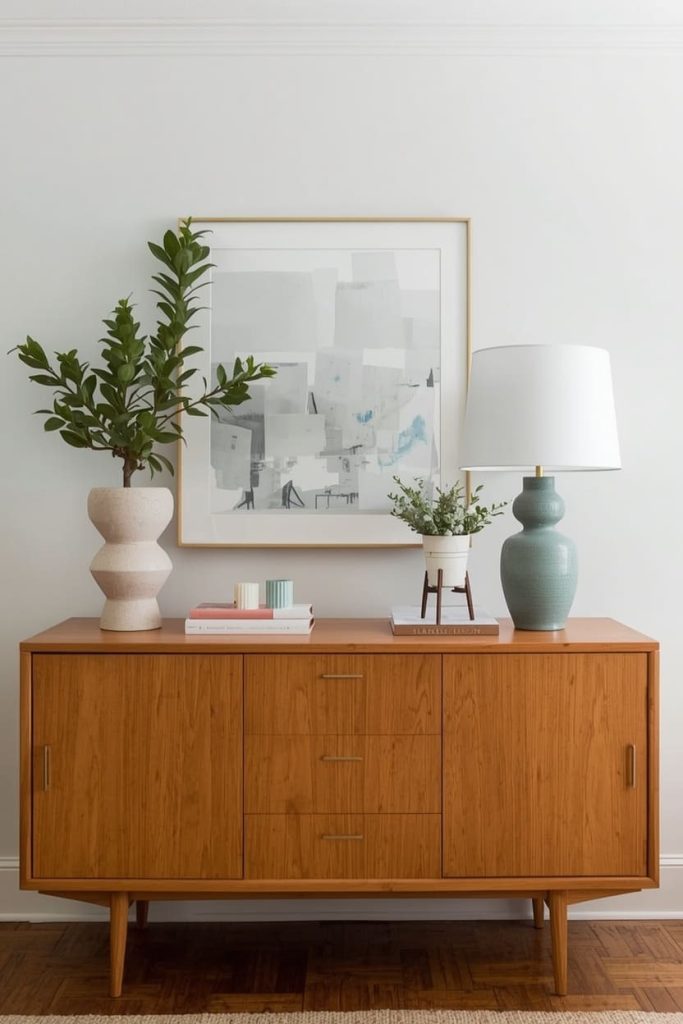
The top of a sideboard is one of the best styling surfaces in your entire home, and for a long time I completely wasted mine by just stacking mail and random objects on it. Once I started treating it intentionally, it became the most visually interesting part of my dining room.
The formula I use — and that I’ve seen designers use consistently — is to work in odd numbers and vary the heights. Start with one tall anchor piece: a piece of art leaning against the wall, a large mirror, or a tall vase.
Then add a mid-height element like a table lamp, a potted plant, or a sculptural object. Finally, add one or two low items — a small tray, a candle, a stack of books — to ground the arrangement.
Leave some of the surface deliberately empty. Negative space is not wasted space — it’s what keeps the styling from feeling cluttered. I aim for roughly 40 percent of my sideboard top to be clear at all times.
That breathing room is what makes the styled sections actually stand out and register as intentional rather than chaotic.
For you, starting with just three objects and building from there is the fastest way to get this right.
Turn Your Sideboard Into a Home Bar That’s Ready When You Entertain
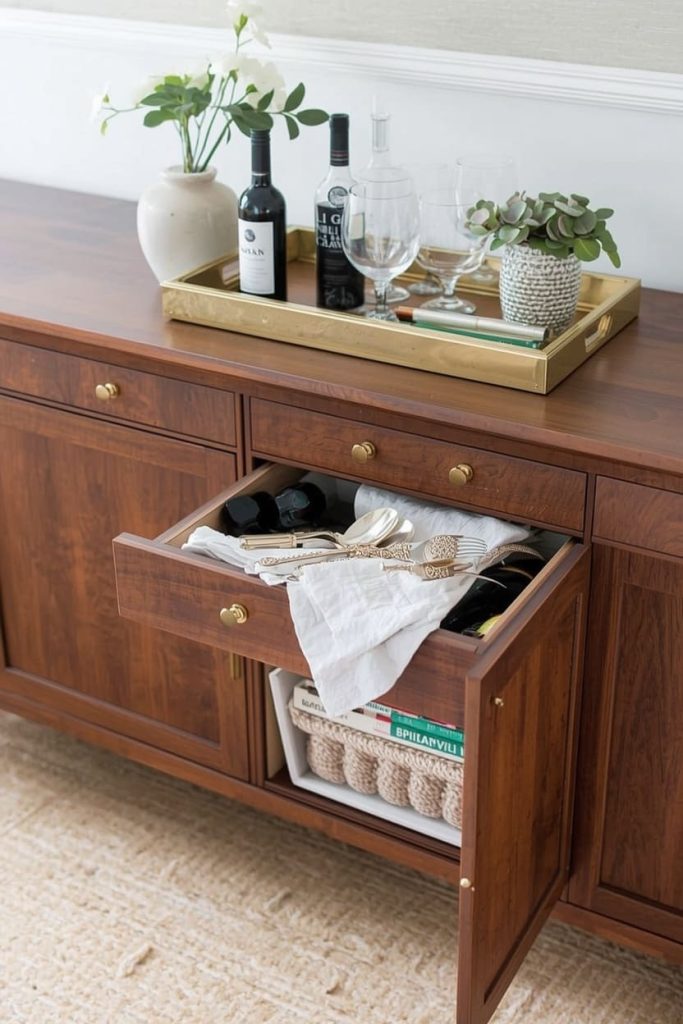
This is one of my favorite dual-purpose ideas, and once I set it up this way I couldn’t imagine using the sideboard surface for anything else.
Dedicating one end of your sideboard top to a styled home bar station makes entertaining feel effortless and gives your dining room a genuinely grown-up, intentional energy.
You don’t need a lot to make it work. A small tray to corral everything, two or three bottles of whatever you actually drink, a set of matching glasses, and one decorative element — a small plant, a candle, or a linen cocktail napkin folded neatly — is genuinely all it takes.
The tray does the heavy lifting by containing the arrangement so it looks styled rather than cluttered.
Inside the sideboard cabinet, store your overflow: extra bottles, a wine opener, cocktail napkins, and any bar tools you use regularly.
That way, when guests arrive, everything you need is within arm’s reach and the surface above looks polished rather than like a liquor store shelf.
For you, this setup also makes weeknight dinners feel slightly more special — there’s something about having a proper place to pour a glass of wine before sitting down that just elevates the whole experience.
Match Your Sideboard Finish to Your Table Without Being Too Matchy
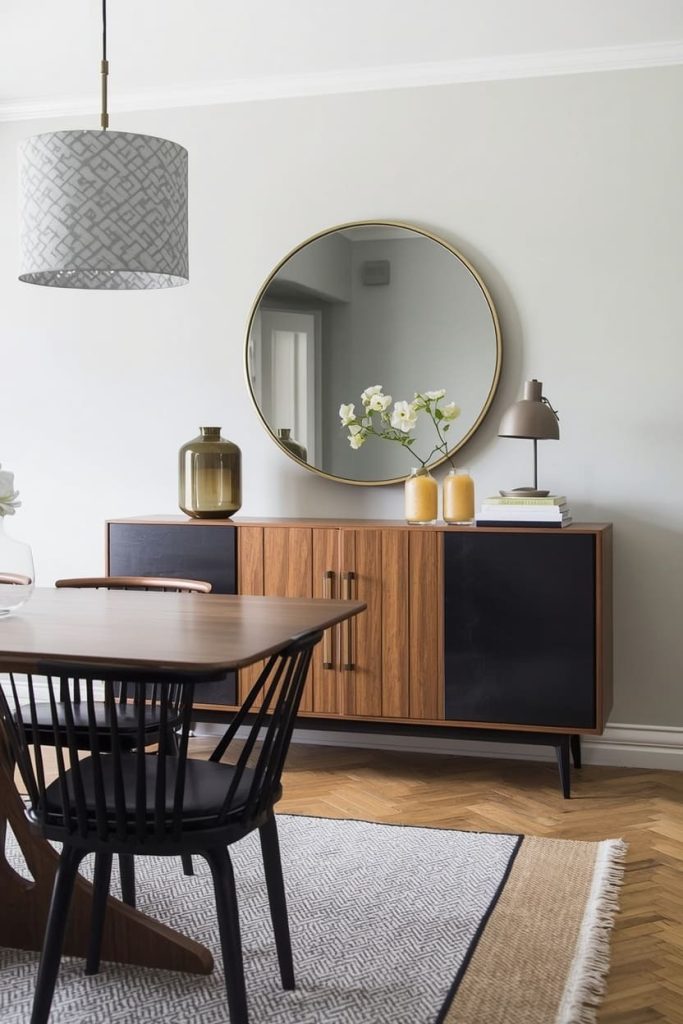
One of the design rules I had to unlearn was that everything in a room needs to match. In a modern dining room, matchy-matchy actually reads as dated and flat.
What you’re going for instead is a finish relationship — pieces that are clearly in conversation with each other without being identical.
If your dining table is a warm walnut, your sideboard doesn’t need to be walnut too. It could be a lighter oak, which picks up the warm wood tone without duplicating it exactly.
If your table is white or painted, a sideboard in a contrasting natural wood finish creates a modern layered look that feels intentional rather than accidental.
The finish I find works in most dining rooms is a warm medium wood — walnut, oak, or teak — because it bridges naturally between both warm and cool color palettes. If your dining room leans more industrial or contemporary, a black metal and wood sideboard adds edge without competing with your table.
The one combination I’d steer you away from is matching the sideboard and table in the exact same wood finish and tone.
Unless they’re from the same collection, the slight variations will look like a mistake rather than a choice. Intentional contrast always looks better than accidental near-matching.
Add Lighting Above or On Your Sideboard to Transform the Room at Night
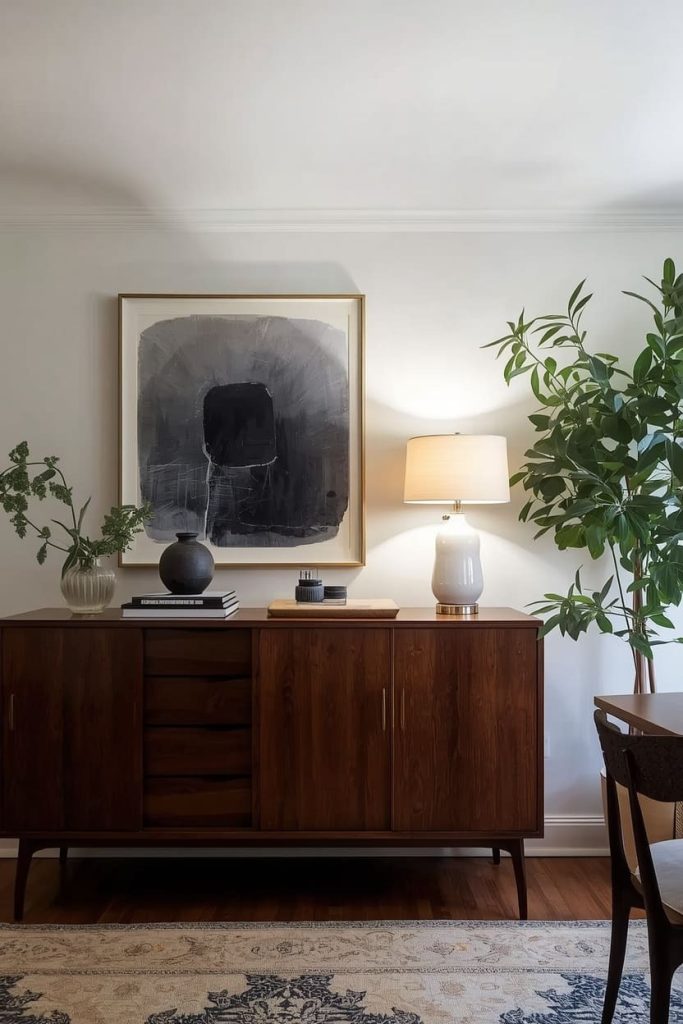
Lighting is the detail that separates a dining room that looks good in photos from one that feels genuinely warm and inviting in real life.
When I added a picture light above the art on my sideboard and a small table lamp at one end, my dining room went from flat to atmospheric — and it cost less than a hundred dollars total.
There are three lighting approaches that work well with a sideboard. The first is a picture light or wall sconce mounted directly above it, which draws the eye to the wall and creates a warm glow that bounces off whatever you’ve styled on top.
The second is a table lamp placed at one end of the sideboard — it adds height variation to your styling and casts soft, directional light that makes the whole room feel cozier.
The third is small LED puck lights or strip lighting inside the cabinet if your sideboard has glass doors or open shelving — it makes the interior feel like a display rather than just storage.
For you, even one lamp on the sideboard makes a significant difference on dinner nights when you dim the overhead light and want the room to feel like an experience rather than just a place to eat.
Use the Inside of Your Sideboard to Solve Your Dining Room Storage Problem
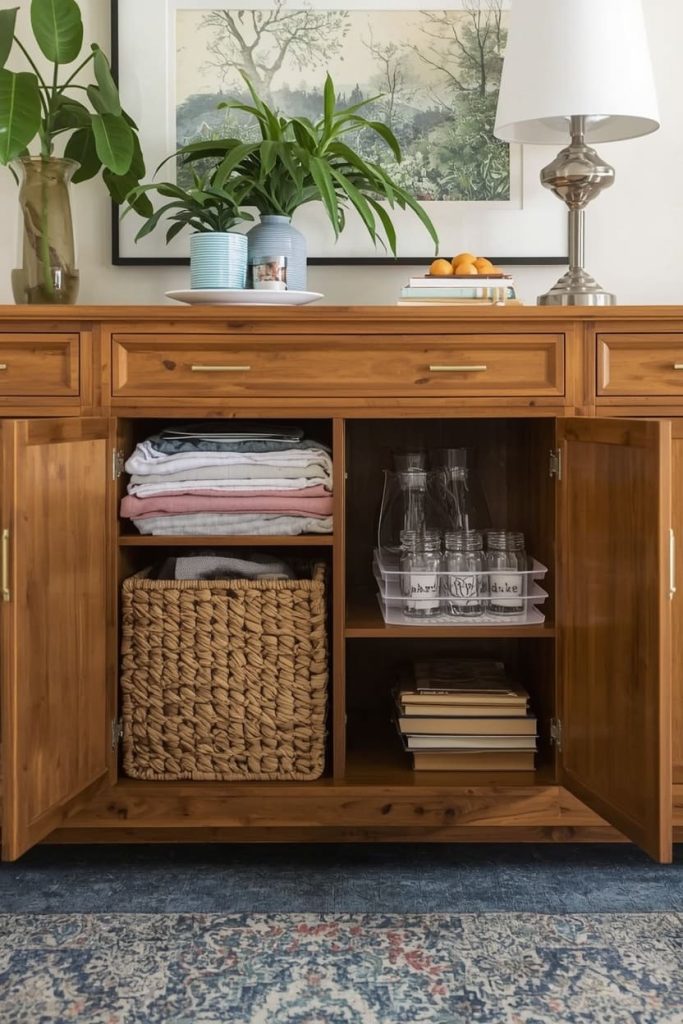
A sideboard earns its place in a room not just by looking beautiful but by quietly solving a storage problem that most dining rooms have — all the stuff that belongs in the dining room but has nowhere intentional to live.
I use the inside of my sideboard for tablecloths and linen napkins, extra candles, placemats, serving platters, a wine opener, and the random things that used to pile up on my kitchen counter because there was nowhere else to put them.
Having a dedicated home for all of it means my table stays clear, my kitchen stays calmer, and hosting feels less chaotic.
The key to making sideboard storage actually work is organizing the interior so you’re not just shoving things in and hoping for the best.
I use shallow drawer dividers for small items, roll linens instead of folding them flat so they don’t wrinkle, and store platters vertically using a simple file organizer insert so I can grab them without unpacking everything else first.
For you, before you buy a sideboard, make a quick list of what you’d store inside it. That list will tell you whether you need more drawer space, more cabinet depth, or a combination of both.
Use Your Sideboard as the Anchor for a Gallery Wall That Makes the Room Feel Complete
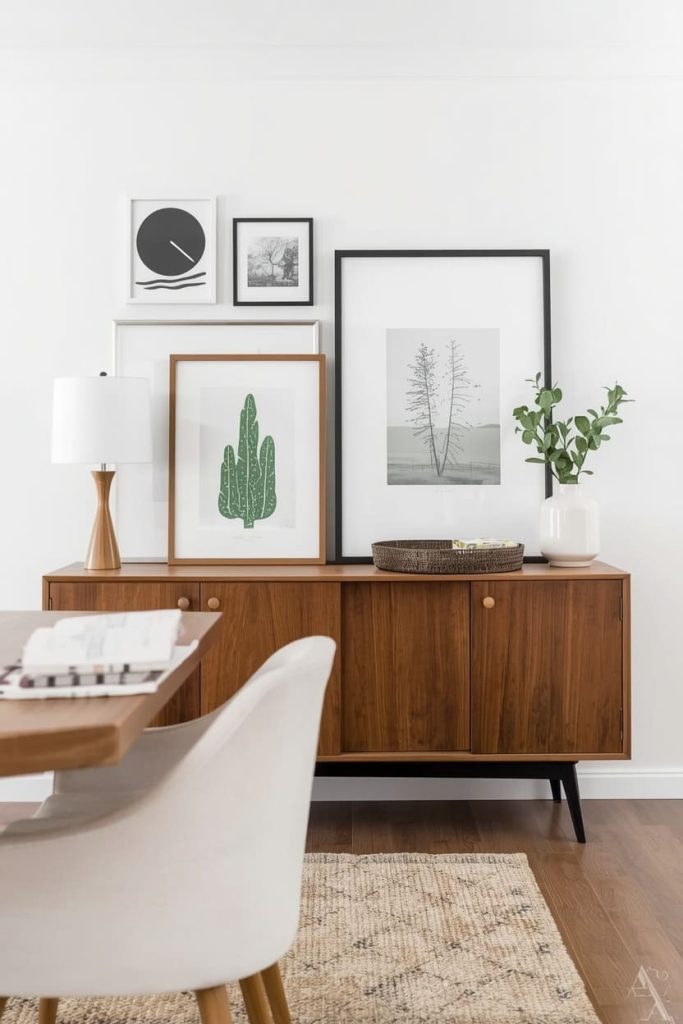
The wall above a sideboard is one of the best gallery wall locations in any home because the sideboard itself gives the arrangement a natural base and a defined lower boundary.
Without that anchor, gallery walls can float awkwardly on a wall and feel unresolved. With a sideboard below, the whole composition feels grounded and intentional.
When I built the gallery wall above my sideboard, I kept the art within the width of the sideboard rather than extending it wider —
that contained relationship between the furniture and the wall art is what makes it feel like a cohesive moment in the room rather than two separate decorating decisions happening near each other.
For a modern dining room, I’d suggest keeping the gallery wall simple: three to five pieces in complementary frames, a mix of one larger piece and several smaller ones, and a palette that pulls colors from elsewhere in the room.
Black frames on a white wall read as clean and contemporary. Natural wood frames feel warmer and more relaxed.
For you, leaning one large piece of art against the wall rather than hanging a full gallery is also completely valid — and honestly, it’s how I started before I was ready to commit to putting holes in the wall.
Frequently Asked Questions About Dining Room Sideboards
What is the ideal height for a dining room sideboard?
Most dining room sideboards fall between 30 and 36 inches tall, and that range works well for most standard rooms. This height keeps the top surface accessible for serving, sits comfortably below eye level when you’re seated, and allows art or mirrors hung above it to remain the visual focal point rather than competing with the furniture itself.
How far should a sideboard be from the dining table?
You want a minimum of 36 inches between the front edge of your sideboard and the nearest dining chair when that chair is pulled out. This gives people enough room to move comfortably behind seated guests and to access the sideboard without disrupting the table. In smaller dining rooms, 36 inches is the floor — don’t go below it.
What do you put on top of a modern sideboard?
The most effective sideboard tops combine a tall anchor element like art or a mirror, a mid-height piece like a lamp or vase, and one or two low items like a tray or candles. Keep roughly 40 percent of the surface clear. In a modern dining room, less is always more — a few well-chosen objects styled with intention will always look better than a crowded surface.
Is a sideboard the same as a buffet table?
They’re closely related but not identical. A buffet is typically longer and lower, designed specifically for serving food during meals. A sideboard is slightly taller, often includes more enclosed storage like drawers and cabinets, and is designed as much for everyday storage as for serving. In modern usage the terms are often used interchangeably, but a sideboard generally offers more versatile, year-round functionality.

Jenny is a passionate writer specializing in home decor, design, and styling. With years of experience in transforming spaces, she shares expert tips on creating beautiful, functional homes. From interior design trends to DIY decor ideas, Jenny’s work helps homeowners craft spaces that reflect their unique style. Whether it’s a cozy living room, a modern kitchen, or a serene bedroom, her articles offer practical advice and inspiration to elevate any home.