Choosing a dining room rug sounds simple until you’re three hours deep into scrolling, second-guessing every option.
Will it be too small? Will the chairs catch on the pile every time someone stands up? What happens when someone spills red wine — again? These are real concerns, and they’re exactly why so many dining rooms end up with no rug at all.
But here’s the truth: the right rug is the single fastest way to make a dining room feel finished, warm, and intentional. You just need to know what to look for.
Consider this your no-stress guide to finding the one that actually works for your space and your life.
Top 5 Dining Room Rugs to Shop on Amazon Right Now
- Ruggable Washable Indoor/Outdoor Area Rug — Cali Cream — A machine-washable, low-profile flatweave rug available up to 9×12 feet in soft neutral tones, perfect for families who want style without the stress of stains.
- Safavieh Montauk Collection Flatweave Cotton Rug — A handwoven cotton flatweave in classic geometric patterns, available up to 9×12 feet, ideal for boho, farmhouse, or eclectic dining rooms that need durability and charm.
- nuLOOM Rigo Jute Area Rug (8×10) — A chunky hand-woven jute rug in natural tones that brings organic warmth and texture to neutral or earthy dining rooms without shedding excessively.
- Artistic Weavers Odessa Vintage Distressed Rug — A low-pile distressed Persian-style rug in faded blues and creams, available in sizes up to 9×12, suited to eclectic, traditional, or transitional dining spaces.
- MISC HOME Geometric Trellis Area Rug (8×10) — A bold, low-pile geometric rug in black and ivory that anchors modern, Scandinavian, or contemporary dining rooms with graphic confidence.
The 7 Ideas
Flat-Weave Rugs: The Most Chair-Friendly Option You’ll Ever Own
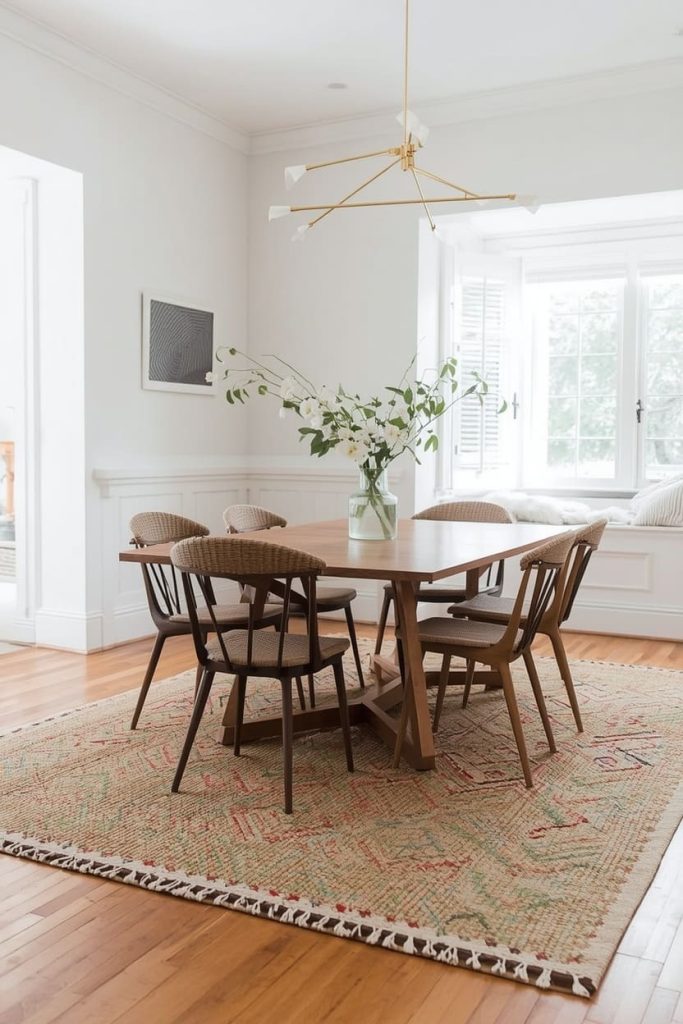
If there is one rug type that was practically engineered for dining rooms, it’s the flat-weave. These rugs have little to no pile — meaning no loops, no high fibers, and no friction to catch on chair legs every time someone pulls their seat in or out. The result is smooth, effortless movement that protects both your floors and your sanity.
Flat-weave rugs are typically made from cotton, wool, or synthetic blends and woven tightly on a loom, producing a slim, durable profile that lies perfectly flat without curling. They’re also significantly easier to clean than high-pile alternatives — crumbs sit on the surface rather than embedding in the fibers, making a quick vacuum or shake all it takes for everyday maintenance.
Style-wise, flat-weaves come in an enormous range — geometric prints, classic stripes, bohemian kilim patterns, and simple solids — so you’re not sacrificing aesthetics for practicality.
Size up generously: an 8×10 is the minimum for most dining tables, and a 9×12 is ideal for tables seating six or more. Make sure all chair legs stay on the rug even when pulled out.
This is the ideal choice for anyone who wants a beautiful, low-maintenance dining room rug that works as hard as the rest of the room.
Washable and Indoor-Outdoor Rugs: The Honest Choice for Real Families
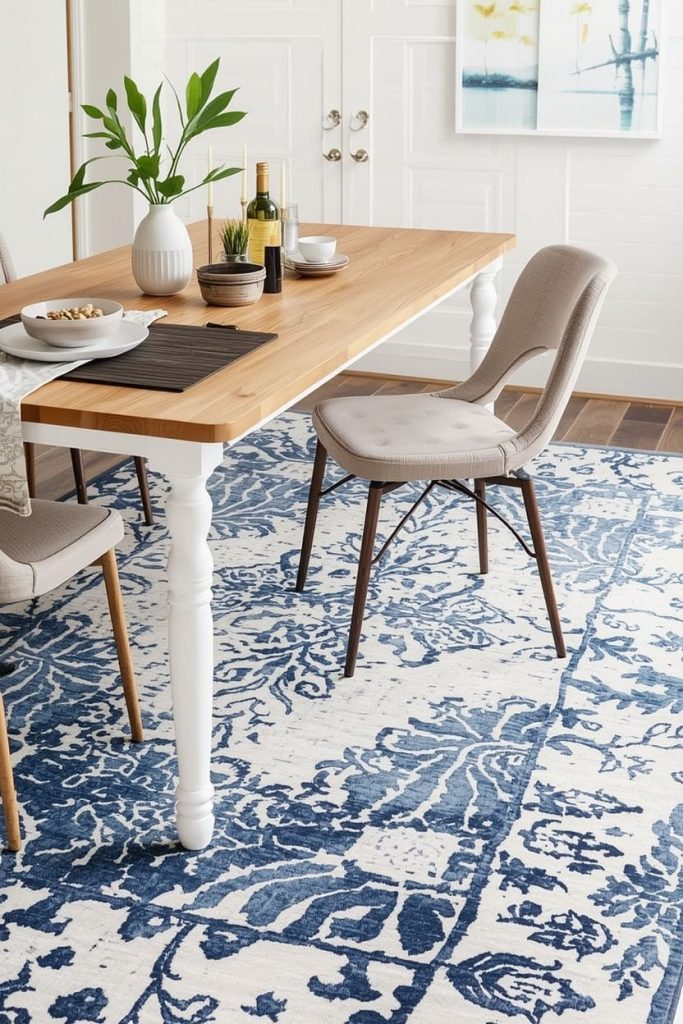
Let’s be honest — dining rooms get dirty. Between kids, pets, dinner parties, and everyday meals, a rug under a dining table takes more abuse than almost any other surface in the home. If the thought of a permanent stain keeps you from committing to a rug at all, a washable or indoor-outdoor rug is the answer you’ve been waiting for.
Washable rugs — led by brands like Ruggable — feature a two-piece system where the rug cover detaches and goes straight into a standard washing machine. Spill red wine, drop pasta sauce, track in mud — it doesn’t matter. The whole thing comes clean in a single wash cycle. Indoor-outdoor rugs made from polypropylene are similarly bulletproof: water-resistant, UV-stable, and wipeable with a damp cloth or garden hose.
Both options have improved dramatically in terms of design quality. You’ll find beautiful geometric prints, classic neutrals, vintage-inspired patterns, and modern abstracts — nothing about them reads as “practical compromise.”
Look for low-pile or flatweave versions to ensure smooth chair movement, and choose sizes of 8×10 or larger to properly anchor your dining table.
This is the perfect dining room rug option for families with young children, pets, or anyone who loves to entertain and refuses to spend the evening anxious about spills.
Natural Fiber Rugs: Add Warmth and Organic Texture That Elevates Any Style
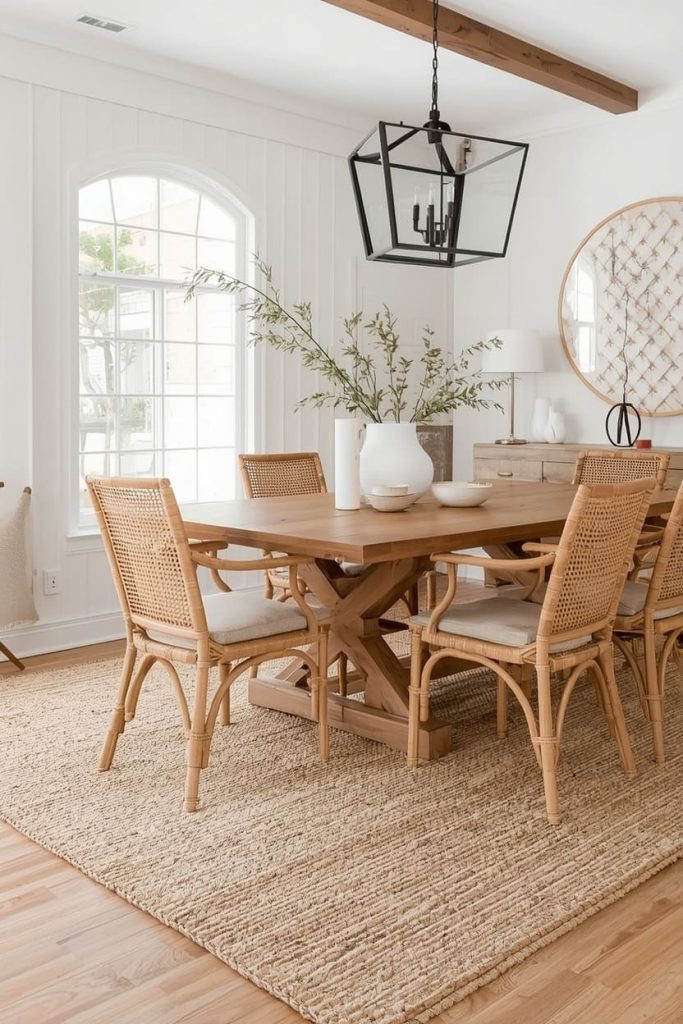
Jute, sisal, seagrass, and hemp rugs have become a staple of well-designed homes for good reason — they bring a natural warmth, tactile texture, and earthy grounding that synthetic rugs simply cannot replicate. In a dining room, a natural fiber rug works as a beautiful neutral foundation that complements virtually every furniture style and color palette.
Jute is the most popular choice for dining rooms because it’s softer underfoot than sisal, available in a range of natural tones from pale blond to deep caramel, and pairs effortlessly with wood tables, rattan chairs, linen upholstery, and both light and dark walls. A chunky woven jute rug in an 8×10 or 9×12 adds enormous visual warmth without adding visual noise — it anchors the space quietly and confidently.
The practical caveat: natural fiber rugs are not ideal for households with frequent heavy spills, as moisture can cause jute to stain or mildew if not dried quickly. For light-use dining rooms or adults-only households, this is rarely an issue.
Choose a low-pile or flat-woven jute for the smoothest chair movement, and consider a rug pad underneath to prevent slipping and extend the rug’s life.
This look suits you perfectly if your dining room leans organic, coastal, farmhouse, Japandi, or bohemian and you want a foundation that feels natural and timeless.
Vintage and Distressed Rugs: Bring Character and Warmth Without Trying Too Hard
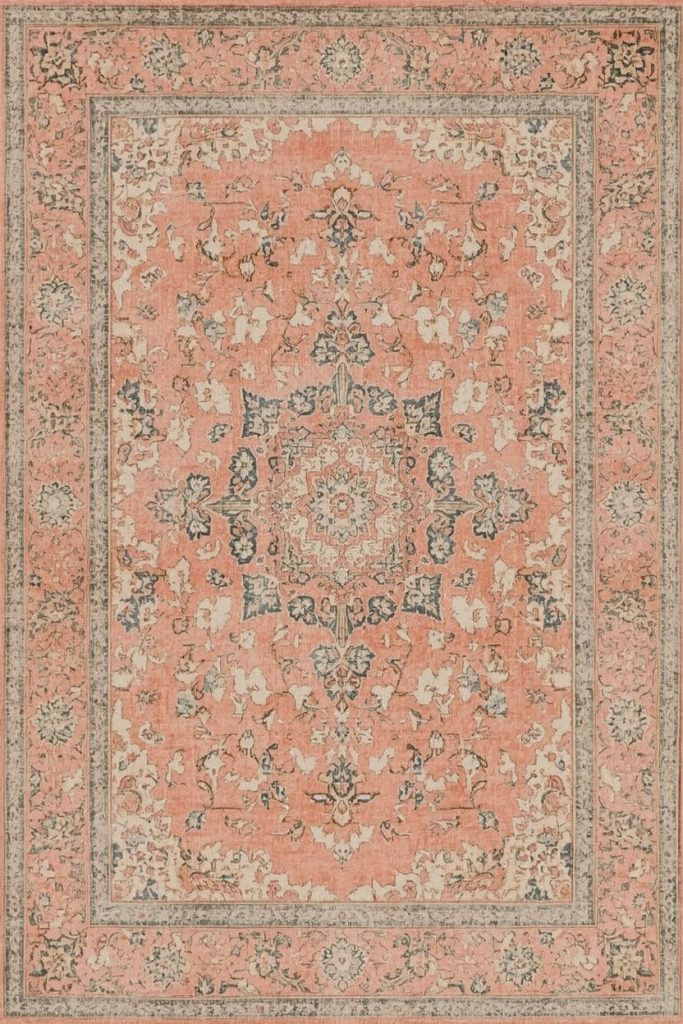
There is something uniquely special about a vintage or distressed-style rug under a dining table. The faded colors, worn patterns, and sense of history make a room feel layered, collected, and genuinely lived-in — which is exactly the feeling most of us are chasing when we decorate.
Vintage and distressed rugs typically feature traditional Persian, Oriental, or medallion patterns in muted, time-softened tones — dusty rose, faded blue, soft terracotta, aged cream. They work in almost every dining room style because their faded palette acts as a neutral that bridges old and new, formal and casual, colorful and restrained.
One of the most practical benefits of a distressed rug in a dining room is that its pattern already looks aged — meaning real-life wear, fading, and the occasional stain tend to blend right in rather than standing out. This makes it one of the most forgiving options for high-use dining spaces.
Look for low-pile versions in polypropylene or wool-blend construction for the best combination of beauty and durability. Avoid high-pile vintage rugs, which will catch on chair legs.
This idea is for you if you want your dining room to feel warm, characterful, and effortlessly stylish without looking like you tried too hard.
Bold Patterned Rugs: Make the Floor the Focal Point of the Whole Room
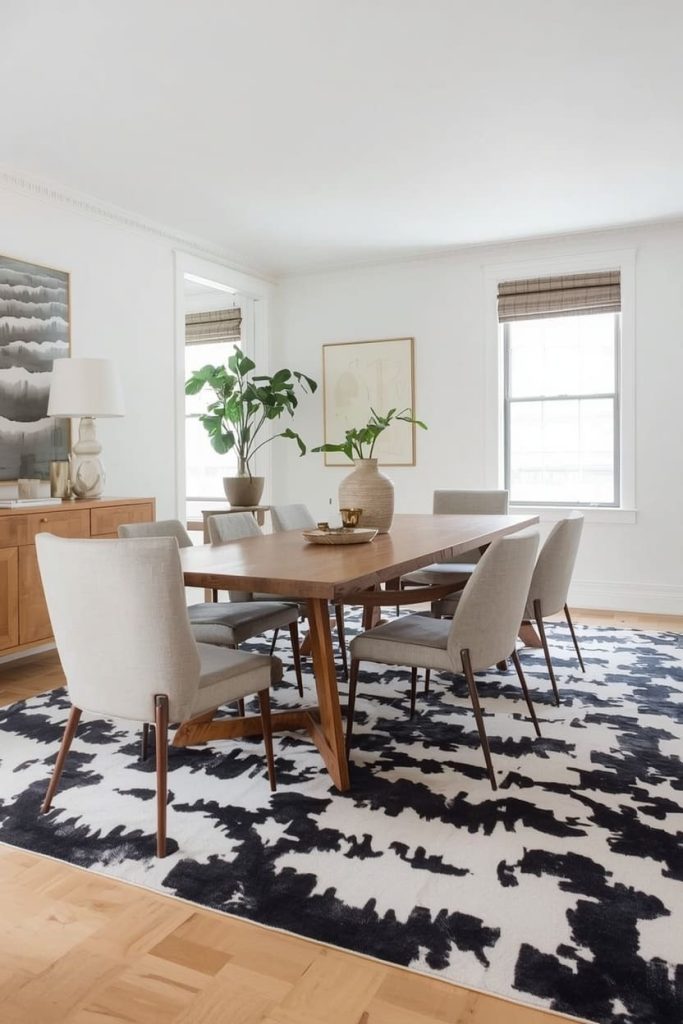
If your dining room furniture is relatively simple — a classic wood table, neutral upholstered chairs, white walls — a bold patterned rug is your opportunity to inject serious personality into the space from the ground up. A strong geometric, graphic, or large-scale print rug can single-handedly define the entire aesthetic of a dining room.
Think oversized black and white checkerboard, dramatic Moroccan trellis, bold abstract brush strokes, or a high-contrast ikat print. These rugs don’t just decorate a room — they anchor it, making the dining area feel intentional and designed rather than assembled.
The key to making a bold rug work is restraint everywhere else. If the rug is doing the heavy lifting visually, keep the furniture simple, the walls calm, and the table accessories minimal. Let the rug be the star.
Practically, look for low-pile or flatweave bold-patterned rugs so chair movement remains smooth. Dark backgrounds and busy patterns are also forgiving of crumbs and everyday debris — another bonus for dining room use.
Size matters more than ever with a bold rug: go 9×12 or larger so the full pattern has room to breathe and the design reads correctly beneath a full-sized dining table.
This works beautifully for you if your dining room walls and furniture are neutral and you want one powerful design statement that transforms the whole space instantly.
Neutral Solid Rugs: The Quietly Confident Choice That Goes With Everything
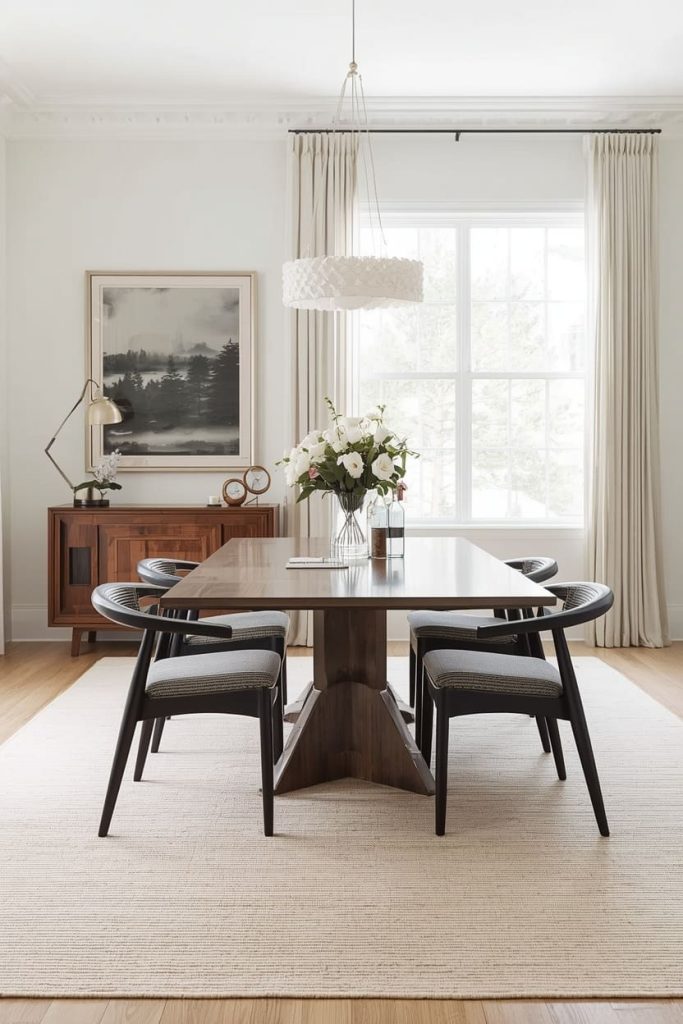
Neutral solid rugs are often underestimated — dismissed as the “safe” choice — but in a dining room, a beautifully textured solid rug in the right tone is one of the most sophisticated decisions you can make. It lets your furniture, lighting, and table styling take center stage while the rug does its job quietly and elegantly.
The secret is in the texture and tone. A flat solid rug in the wrong shade looks flat and forgettable. But a solid rug in warm ivory, soft sage, dusty blush, deep charcoal, or warm terracotta — especially with a subtle texture like a ribbed weave, a cut-loop pattern, or a boucle surface — reads as intentional, elevated, and carefully chosen.
Solid rugs are also the most versatile investment you can make for a dining room, because they transition seamlessly when you update your furniture, repaint your walls, or change your table styling seasonally.
For maximum impact, choose a tone that either matches or deliberately contrasts your flooring — a warm cream rug on light oak floors blends beautifully, while a deep charcoal rug on pale wood creates striking definition.
This is the right choice for you if you want a long-term foundational rug that adapts to your evolving style and never feels dated or trend-dependent.
Layered Rugs: The Designer Trick That Makes a Dining Room Look Twice as Styled
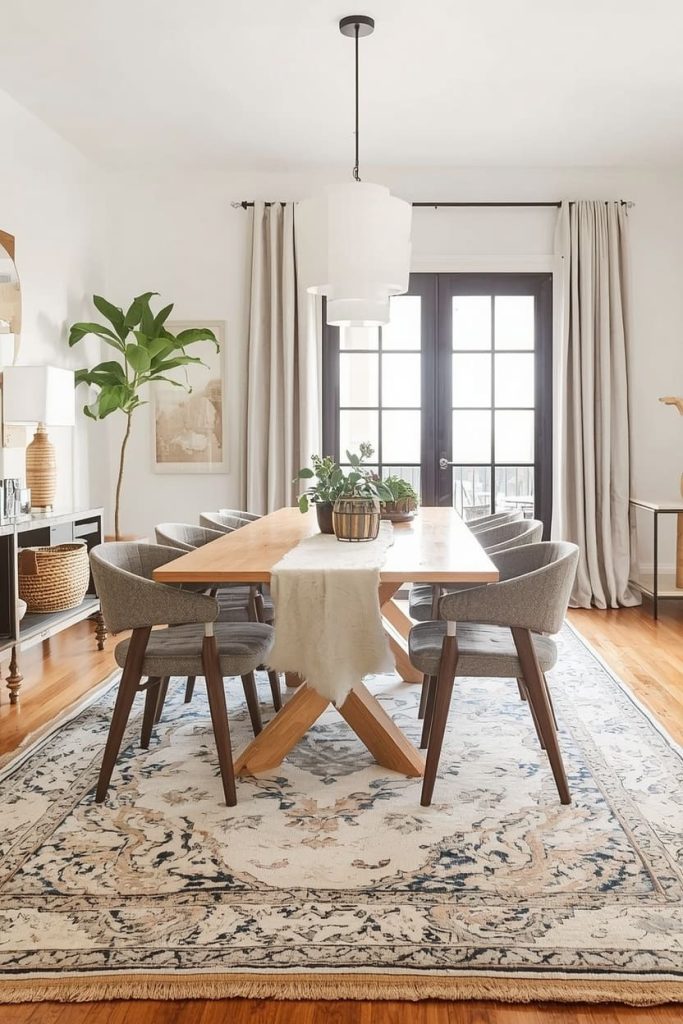
Layering rugs in a dining room is one of those design moves that looks complicated but is actually very simple — and the result looks like you hired an interior designer. The technique involves placing a smaller, more decorative rug on top of a larger, simpler base rug, creating depth, texture, and a collected, editorial quality that a single rug can never achieve alone.
The most common approach is to use a large natural fiber rug — a jute or sisal in 9×12 or larger — as the base layer, then center a smaller vintage, patterned, or sheepskin rug on top. The natural fiber provides the practical, durable foundation while the top rug adds personality and visual interest.
In a dining room specifically, keep the top rug centered under the table so chair legs primarily interact with the flat base rug rather than the layered piece. This protects the decorative top rug from excess wear and keeps chair movement smooth.
Use this approach to refresh a dining room you already love without replacing the existing rug — simply layer something new and interesting on top to give the whole space a fresh feeling.
This idea is for you if you love a layered, bohemian, or eclectic aesthetic and want your dining room to feel genuinely designed rather than simply furnished.
Frequently Asked Questions
What is the best rug size for a dining room table?
The most important rule is that all chair legs — including when the chairs are pulled out — should remain on the rug. For a table seating four to six, an 8×10 foot rug is typically the minimum. For tables seating six to eight, go with a 9×12. For large rectangular tables seating ten or more, consider a 10×14. When in doubt, size up — an oversized rug always looks more intentional than one that’s too small.
What type of rug material is easiest to clean under a dining table?
Polypropylene (synthetic) rugs are the easiest to clean — they resist stains, dry quickly, and can often be wiped down with a damp cloth. Machine-washable rugs like Ruggable are the gold standard for families with kids or pets. Flatweave cotton rugs are also easy to clean and sometimes machine washable. Natural fibers like jute are beautiful but more vulnerable to moisture — best for lower-traffic or adult-only dining rooms.
Should a dining room rug be the same style as the rest of the room?
It doesn’t need to match exactly, but it should feel harmonious. If your dining room is modern and minimal, a bold geometric or solid rug in a complementary tone works well. If your space is traditional, a vintage Persian-style rug feels natural. The most important thing is that the rug’s color palette pulls from tones already present in the room — in the furniture, wall color, or curtains — so it feels connected rather than dropped in randomly.
Can you use an outdoor rug in a dining room?
Absolutely — and it’s actually a brilliant idea for high-traffic dining rooms. Outdoor rugs made from polypropylene are extremely durable, stain-resistant, and easy to clean with a damp cloth or even a hose. They’ve come a long way in design quality and now come in beautiful geometric, striped, and abstract patterns that look completely at home indoors. Just choose a flatweave or low-pile version for the smoothest chair movement, and add a rug pad underneath for comfort and grip.
You now have everything you need to choose your dining room rug with complete confidence — the right size, the right material, the right style, and a clear sense of what will actually work for your space and your life. Stop scrolling, grab a tape measure, pick the idea that made you pause, and go for it. The right rug is waiting, and your dining room is going to look incredible.

Jenny is a passionate writer specializing in home decor, design, and styling. With years of experience in transforming spaces, she shares expert tips on creating beautiful, functional homes. From interior design trends to DIY decor ideas, Jenny’s work helps homeowners craft spaces that reflect their unique style. Whether it’s a cozy living room, a modern kitchen, or a serene bedroom, her articles offer practical advice and inspiration to elevate any home.