A few years ago, I stood in my dining room and felt nothing. The walls were a forgettable beige, the lighting was flat, and every dinner felt like eating in a waiting room.
I knew I wanted a change — something sophisticated but warm, timeless but personal. That’s when I discovered grey.
Not the cold, sterile grey you might be imagining, but the kind that wraps a room in quiet elegance and makes every meal feel like an occasion.
Whether you’re starting from scratch or simply refreshing what you have, grey is the most versatile foundation you can choose. Here are seven ideas I love — and I think you will too.
Table of Contents
- Pair Grey Walls With Warm Wood for an Effortlessly Cozy Feel
- Layer Different Shades of Grey for a Designer-Level Look
- Add Brass or Gold Accents to Make Grey Feel Luxurious
- Use a Statement Wall to Add Depth Without Overwhelming the Space
- Bring in Soft Textiles to Make Your Grey Dining Room Feel Inviting
- Style Your Dining Table Like a Magazine Shoot (Without Trying Too Hard)
- Let Natural Light Do the Heavy Lifting in Your Grey Dining Room
My Favorite Grey Dining Room Picks on Amazon
Before we dive into the ideas, here are five products I’d personally reach for to build a beautiful grey dining room:
Stone & Beam Upholstered Dining Chairs in Dove Grey — These cushioned chairs bring softness and sophistication to any grey dining space without overwhelming the room’s palette.
Safavieh Lagoon Collection Grey Area Rug — A low-pile grey rug with a subtle geometric pattern that anchors your dining table and adds quiet texture underfoot.
Threshold Linen-Blend Neutral Table Runner — A warm oatmeal-toned table runner that softens an all-grey palette and adds an organic, lived-in elegance to your table setting.
Article Seno Solid Wood Dining Table — A beautifully minimal walnut-toned table that pairs effortlessly with grey walls and creates that coveted warm-meets-cool contrast.
Rivet Industrial Metal Pendant Light in Matte Black — A statement pendant that draws the eye upward, adds contrast, and instantly elevates a grey dining room from flat to finished.
The 7 Ideas
Pair Grey Walls With Warm Wood for an Effortlessly Cozy Feel
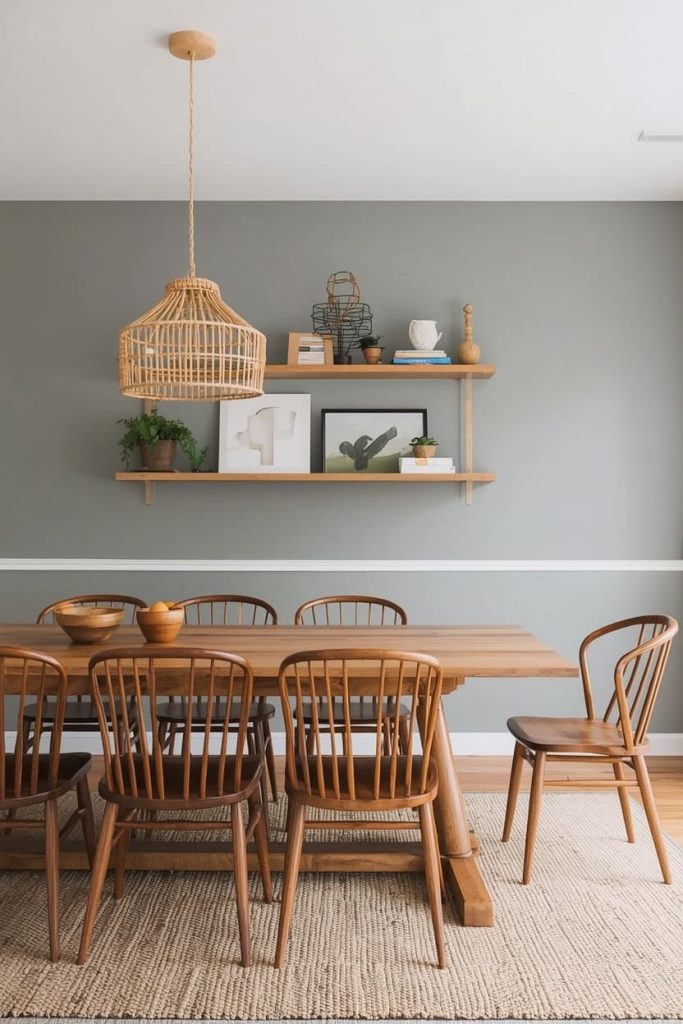
If there’s one combination I keep coming back to, it’s grey walls with warm wood tones.
On their own, grey walls can feel a little cool or reserved — but the moment you bring in a honey-toned oak dining table or a set of wooden chairs with natural grain showing, everything softens.
The warmth of the wood works against the grey like a fireplace against a winter afternoon. It’s the contrast that makes both elements shine.
For wall color, I’d suggest something like Sherwin-Williams’ “Agreeable Gray” or Benjamin Moore’s “Pale Smoke” — both lean slightly warm, which helps bridge the gap between the wall and your wood furniture.
You can take this further by adding a jute rug, a rattan pendant light, or even a reclaimed wood shelving unit on one wall.
The goal is to make grey feel grounded rather than cold. When you nail this balance, your dining room stops feeling like a showroom and starts feeling like a home — the kind where people linger at the table long after the dishes are cleared.
Layer Different Shades of Grey for a Designer-Level Look
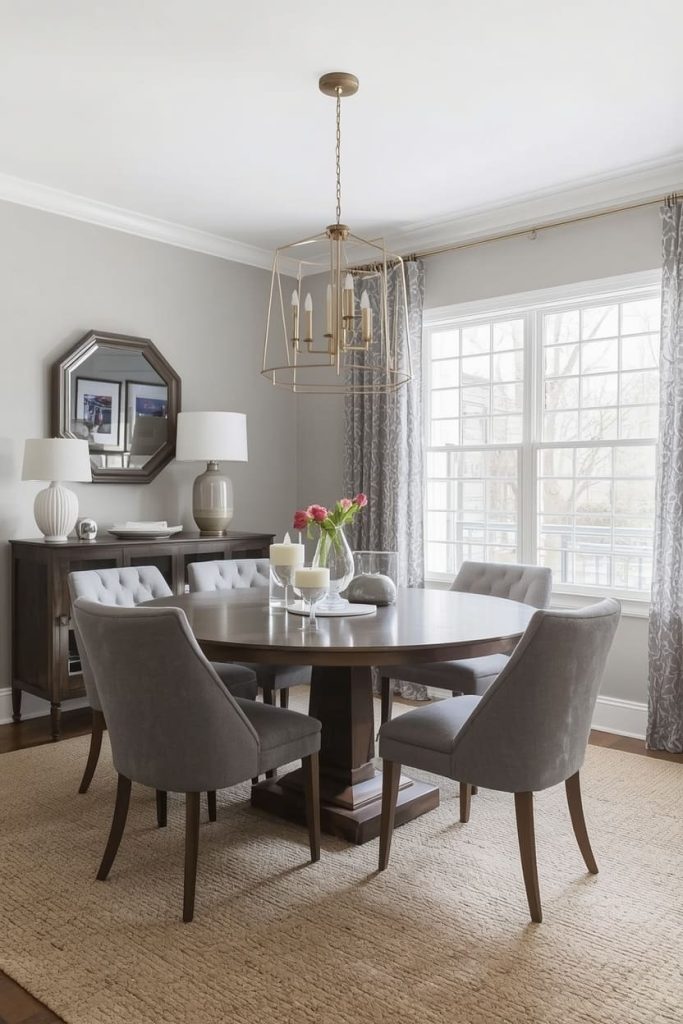
One of the most common mistakes I see in grey dining rooms is treating grey as a single, flat color. The rooms I find most beautiful use grey the way a painter uses shadow — in layers, in shifts, in texture.
Think a soft dove-grey on the walls, a slightly deeper slate on your upholstered dining chairs, and a warm charcoal woven into your area rug. The variation creates depth without chaos.
You don’t need to overthink this. A good rule of thumb is to work in three tones: light, mid, and deep.
Your walls carry the lightest shade, your textiles (cushions, runners, napkins) bring in the mid-tone, and one or two accent pieces — a vase, a picture frame, a candle holder — anchor the space in the deepest shade.
This layering technique is exactly what interior designers charge thousands to do, and you can absolutely achieve it yourself. Stick to the same undertone family — all warm greys or all cool greys — and the room will feel cohesive, curated, and deeply intentional.
Add Brass or Gold Accents to Make Grey Feel Luxurious
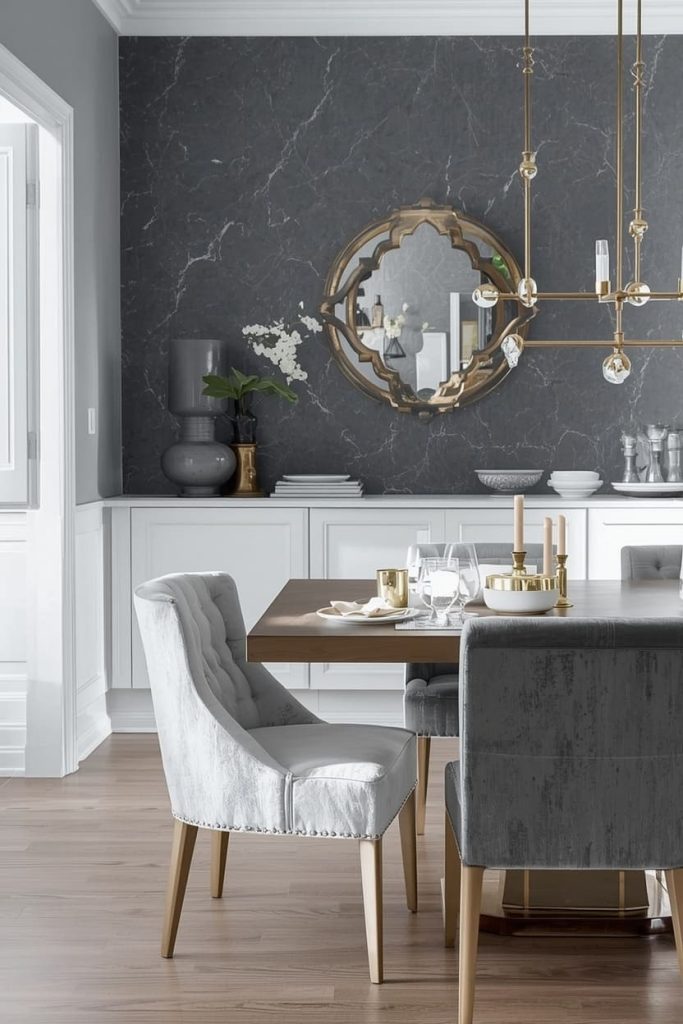
If grey is the canvas, brass is the brushstroke that makes people stop and say “wow.” There’s something about the pairing of cool grey and warm metallic gold that feels genuinely luxurious — like something you’d see in an upscale boutique hotel.
And the best part? A little goes a long way.
You don’t need to redo your whole room. Start with your light fixture — a brass or antique gold pendant over the dining table is one of the highest-impact changes you can make for the budget.
From there, look at your hardware: cabinet handles, curtain rod finials, even picture frame corners. Brass candlestick holders on the table, a gold-rimmed mirror on one wall, or metallic flatware at each place setting — these small touches accumulate into something that looks very deliberate and very expensive.
If you’re worried about brass feeling dated, lean toward brushed or satin brass rather than the shiny polished version.
It reads warmer, more muted, and much more current. Paired against a mid-tone grey like Benjamin Moore’s “Coventry Gray,” the combination feels timeless rather than trendy.
Use a Statement Wall to Add Depth Without Overwhelming the Space
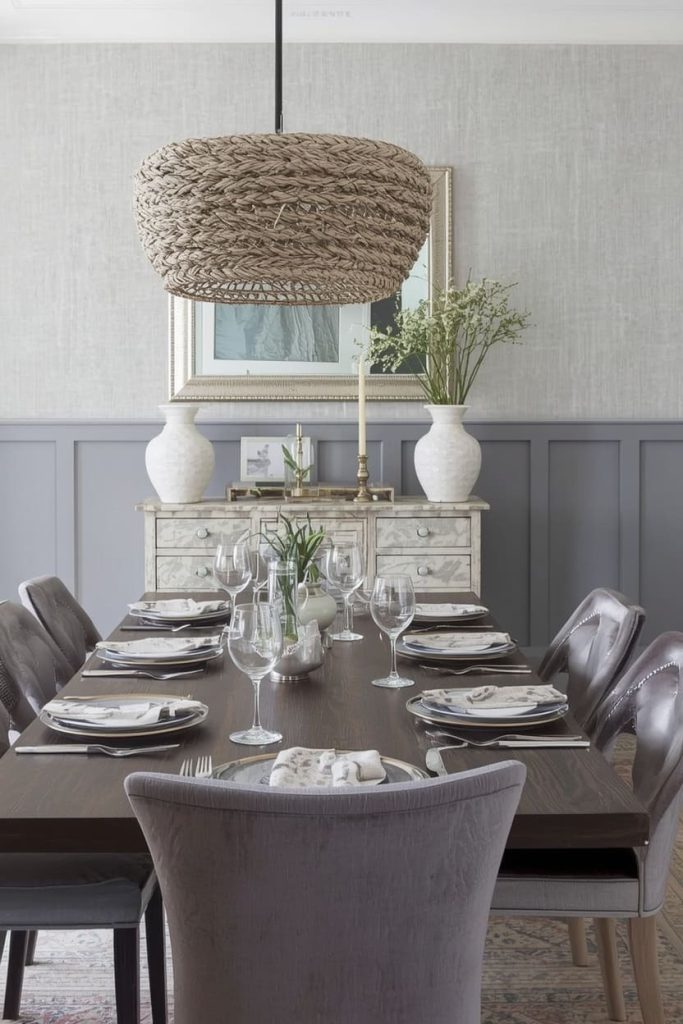
Not every wall in your dining room needs to be the same. One of my favorite grey dining room tricks is to create a single statement wall — usually the one your dining table sits against — using a deeper shade of grey, a textured wallpaper, or even wood paneling painted in a moody charcoal.
This gives the room a focal point and creates the illusion of depth, making even a smaller dining area feel more intentional and designed.
If you go the wallpaper route, look for subtle textures: grasscloth, linen-look, or a soft tonal geometric. These add visual interest without introducing a competing pattern or color.
If you prefer paint, try Farrow & Ball’s “Mole’s Breath” or Sherwin-Williams’ “Gravity” — both are deep, sophisticated greys that work beautifully as accent walls without turning the room cave-like.
Keep the remaining three walls in a lighter grey or even soft white to balance the drama. Then let your furniture and table styling do the rest.
A statement wall is one of those upgrades that makes guests assume you hired a designer — even when all you did was pick a great paint color and trust yourself.
Bring in Soft Textiles to Make Your Grey Dining Room Feel Inviting
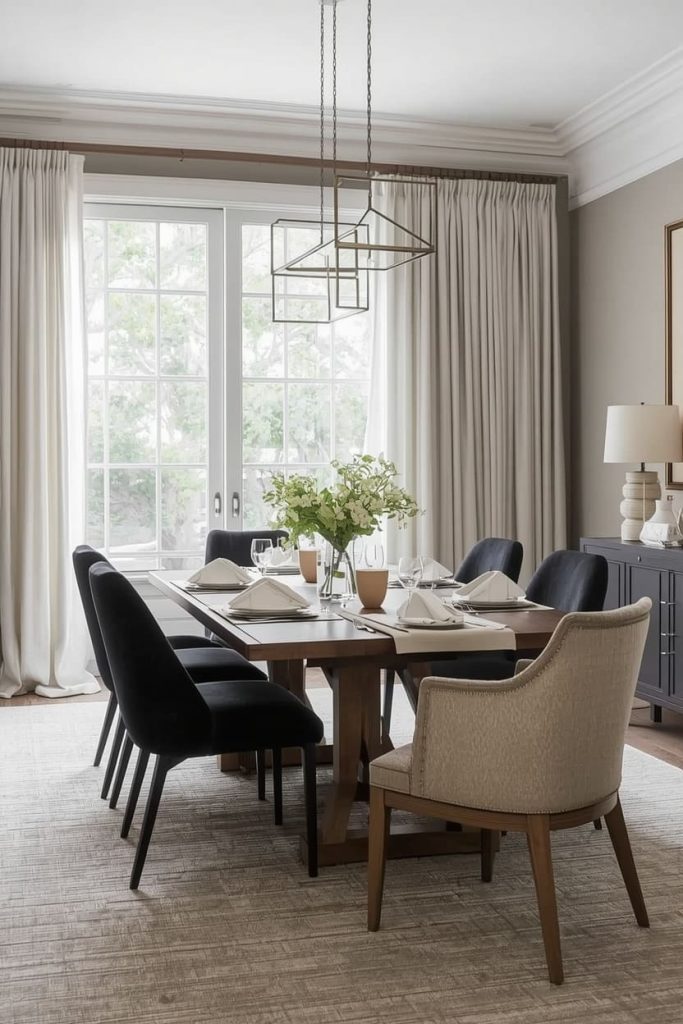
Grey dining rooms can sometimes feel a little austere if the surfaces are too hard and the lines too clean. The fix is almost always textiles.
I’m talking about cushioned dining chairs, a generously-sized area rug, linen curtains that puddle softly onto the floor, and cloth napkins folded at every place setting.
These aren’t just decorative — they’re the difference between a room that looks good in photos and a room that actually feels good to sit in.
For chair cushions, I love a velvet or boucle fabric in a tone slightly lighter or deeper than your walls — it adds tactile richness without visual noise.
For curtains, sheer linen panels in warm white or soft ivory filter natural light beautifully and keep the room from feeling enclosed.
And don’t underestimate the area rug — in a dining room, a rug grounds the table, defines the space, and adds a layer of warmth underfoot that makes the whole room feel more finished.
Think of textiles as your room’s soft architecture — they shape the emotional experience of the space just as much as your furniture does.
Style Your Dining Table Like a Magazine Shoot (Without Trying Too Hard)
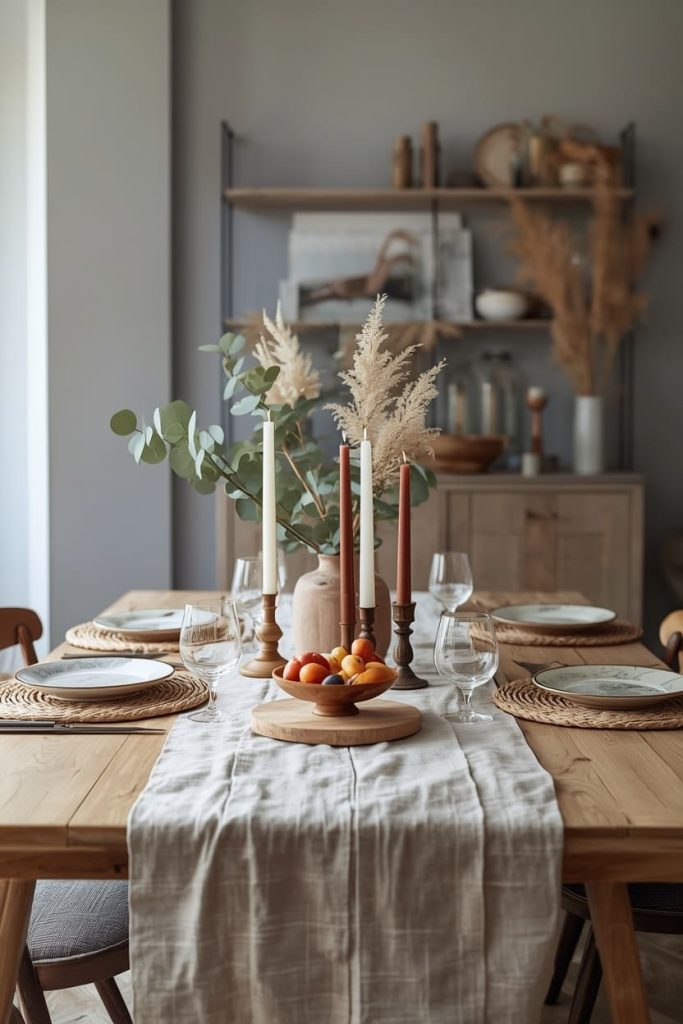
The dining table is the heart of the room, and in a grey dining space, it’s your best opportunity to add warmth, color, and personality.
I’ve found that the most beautiful tablescapes are actually the least complicated — a linen runner, a cluster of varying-height candles, a small vase of eucalyptus or dried pampas grass, and a simple bowl of fruit or nuts.
That’s it. No fussiness, no matching sets, no overthinking.
In a grey room, your table is where you can introduce natural elements and warmer tones. Think terracotta taper candles, a wooden or marble serving board, woven placemats, and greenery. These organic touches do the work of warming up the grey palette without you having to repaint a single wall.
The key is varying your heights and textures. A flat table with perfectly matched items looks staged; a table with a tall candle next to a low vase next to a textured runner looks lived in — and that’s exactly the kind of effortless beauty that makes people want to sit down and stay a while.
Let Natural Light Do the Heavy Lifting in Your Grey Dining Room
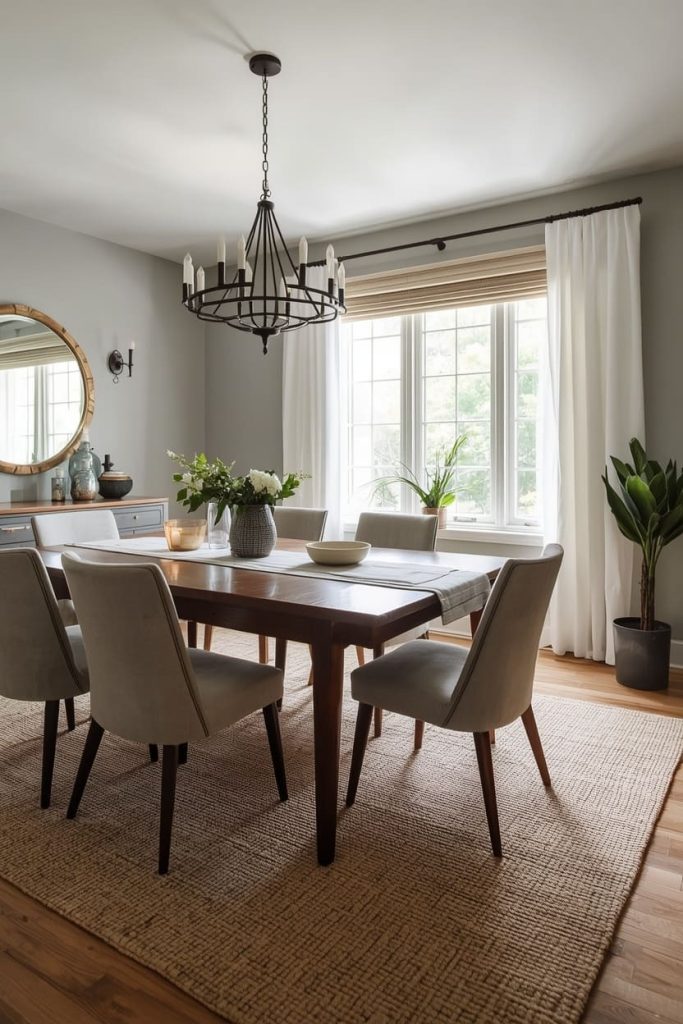
Here’s something I wish someone had told me earlier: the same grey paint can look completely different depending on your light. In a north-facing room with limited windows, a cool grey can feel dim and a little dreary.
In a south-facing room flooded with afternoon sun, that same color glows. Before you commit to any shade, paint large swatches and observe them at different times of day — morning, noon, and evening with your artificial lights on.
To make the most of natural light in a grey dining room, keep window treatments light and airy — sheer linen or lightweight cotton rather than heavy blackout panels.
Use mirrors strategically: a large mirror on the wall opposite your window will reflect light back into the room and make the space feel twice as large. Glossy or semi-gloss paint finishes on trim and ceilings also help bounce light around.
If your dining room doesn’t get much natural light, warm up your artificial lighting instead. Swap cool white bulbs for warm white (2700K), add a dimmer switch, and let candlelight do the rest on evenings when you want the room to feel especially cozy and intimate.
Frequently Asked Questions About Grey Dining Rooms
Q: What are the best grey paint shades for a dining room?
A: Some of my favorites are Sherwin-Williams “Agreeable Gray” (warm and welcoming), Benjamin Moore “Coventry Gray” (classic and versatile), Farrow & Ball “Mole’s Breath” (moody and sophisticated), and Benjamin Moore “Pale Smoke” (light and airy). Always test a large swatch on your actual wall before committing, because undertones shift dramatically depending on your room’s light.
Q: How do I warm up a grey dining room so it doesn’t feel cold?
A: Layer in warm wood tones, brass or gold accents, and soft textiles like linen, velvet, or boucle. Swap cool-toned lightbulbs for warm white ones (2700K), and add organic elements like dried florals, wooden serving pieces, or a jute rug. Warm-toned greys with beige or brown undertones also help — look for shades described as “greige” on the undertone spectrum.
Q: Is grey going out of style for home interiors?
A: Grey has been declared “over” several times, and it keeps proving the critics wrong. True, the icy blue-greys of the early 2010s have faded, but warm, nuanced greys remain a staple in timeless interiors. When paired thoughtfully with wood, brass, and organic textures, grey reads as classic rather than trendy — which is exactly what you want in a space you’ll use every day.
Q: What colors pair best with grey in a dining room?
A: Grey is one of the most versatile neutrals you can work with. Warm wood tones and brass are perennial favorites. White and cream keep things fresh and bright. Deep navy or forest green on an accent wall adds drama. And if you want a bolder look, dusty blush or burnt terracotta in your textiles brings warmth and personality without overwhelming the grey base.
I’ve learned that the best dining rooms aren’t the most expensive ones — they’re the most intentional. You don’t need to overhaul everything at once.
Start with one change: a new rug, a coat of paint, a set of upholstered chairs.
Build from there, layer by layer, until the room reflects exactly the kind of home you want to live in. Grey gives you the perfect foundation — calm, elegant, endlessly adaptable.
Now it’s your turn to make it yours. The most beautiful dining room you’ve ever had is just a few good decisions away.

Jenny is a passionate writer specializing in home decor, design, and styling. With years of experience in transforming spaces, she shares expert tips on creating beautiful, functional homes. From interior design trends to DIY decor ideas, Jenny’s work helps homeowners craft spaces that reflect their unique style. Whether it’s a cozy living room, a modern kitchen, or a serene bedroom, her articles offer practical advice and inspiration to elevate any home.